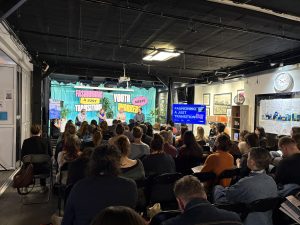
Today, the Clean Clothes Campaign (CCC) is celebrating Living Wage Day worldwide. The number of associations and trade unions participating in this global initiative grows every year, with actions currently taking place in at least forty countries. The ultimate goal of this movement is to have the United Nations officially recognize and observe this day under its auspices.
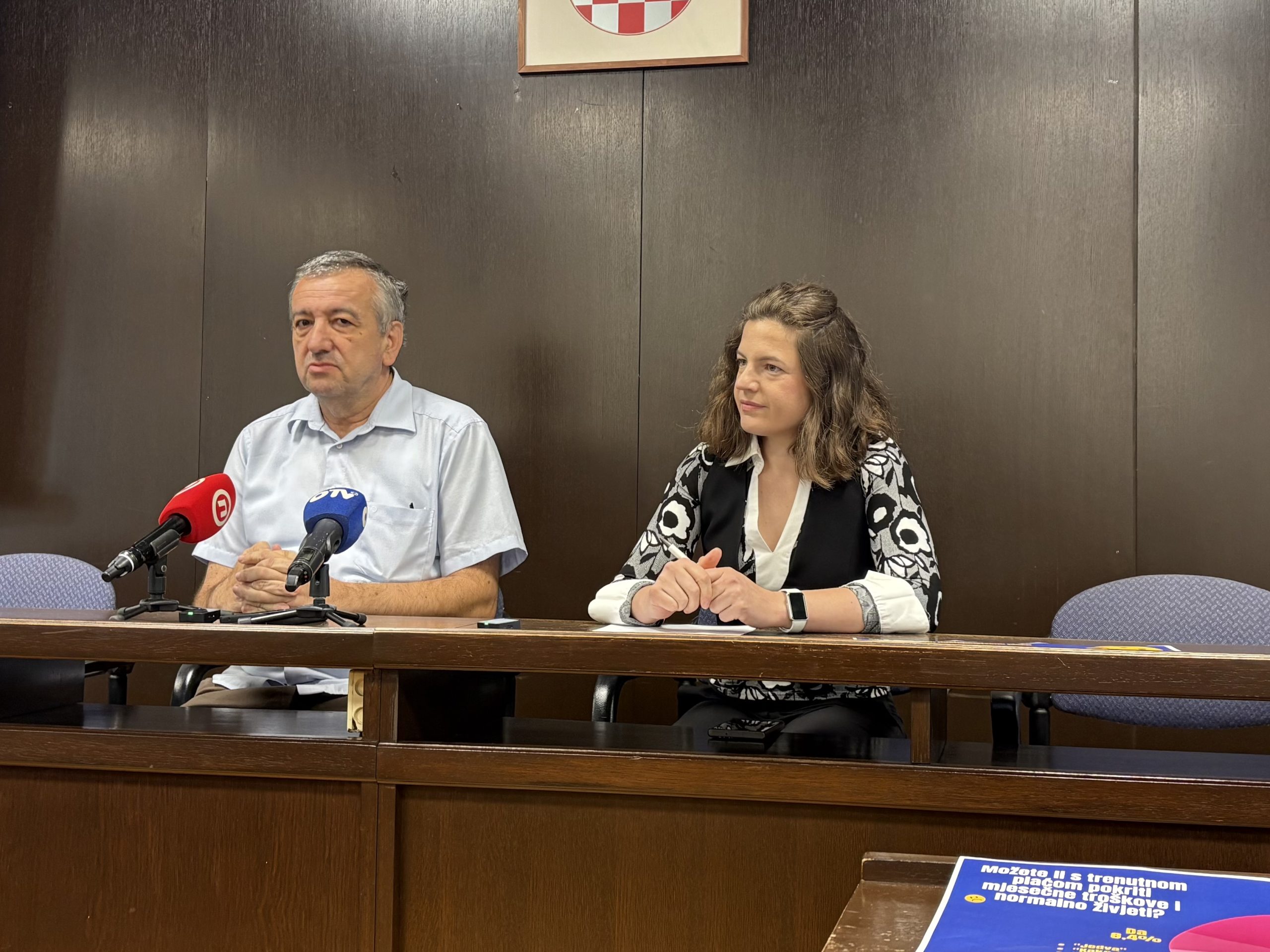
To mark the occasion in Croatia, the Coalition for a Decent Wage held a press conference featuring Mario Iveković, President of Novi sindikat, and Marina Palčić, President of the Independent Trade Union of Croatian Workers (Nezavisni sindikat radnika Hrvatske).
Mario Iveković noted that while talks on wage increases are ongoing, the recent trend of minimum wage growth implemented by the government is a positive step that must continue. Progress is evident: ten years ago, the minimum wage covered only 27 percent of a living wage, whereas today it reaches nearly forty percent.
“According to the Clean Clothes Campaign methodology and our own calculations, a living wage for 2026 would amount to 2,025 euros net,” Iveković stated. “This is a wage that covers all essential expenses for a dignified life housing, food, travel, healthcare, and other necessities within a regular working week. Unlike the minimum wage, which lacks a clear foundation, a decent wage is based on concrete field research of actual living costs.”
Iveković also challenged the Government of the Republic of Croatia on why the non-taxable income threshold is not equal to the minimum wage. “Why is the minimum wage, the absolute minimum a worker can receive, taxed at all? Equalizing the non-taxable base would be a crucial move toward reaching a decent wage. You simply cannot tax the poor,” he concluded.
Marina Palčić emphasized that the minimum wage is often treated as an administrative “crutch” that protects employers and legalizes exploitation. In the retail sector, which employs about 230,000 people, it is common for a portion of the salary to be agreed upon orally through unregulated bonuses, while the official contract only shows the minimum wage.
“As long as the worker remains silent, those extra payments might arrive. But if the worker quits or the employer decides otherwise, that verbal agreement vanishes, and the worker is left only with the legal minimum. In our current system, the minimum is used as a maximum, rather than a floor that must not be crossed,” Palčić warned.
She also addressed the public discourse that often urges workers to be “humble.” Palčić believes that under the guise of modesty, workers are being forced to accept lives without basic needs, cultural content, or social development. This includes depriving children of excursions or quality nutrition, such as fresh fruit, vegetables, and meat.
“Teaching children to give up what should be normal—not a luxury—is not modesty. It is poverty disguised as modesty. This policy keeps workers in a subordinate position. A decent wage is vital because it would cover all those needs within a standard 40-hour work week,” she said.
In her concluding remarks, Palčić stated that the state must take social responsibility by ensuring decent wages through collective bargaining, transparency, and respect for the workers’ voice. “Without decent wages, there is no dignified life, and without the dignity of workers, there is no just society.”
______________________________________
On the occasion of living wage day, the new union conducted a survey on workers ‘ wages and living conditions. We will continue to bring the results.
SALARY SURVEY RESULTS
73.3 percent of respondents work in private companies, 18.9 percent work in state-owned companies, and 7.8 percent are in some other form of employment (non-profit organization, association, own craft).
45.96 percent of respondents have a salary of less than 1000 euros. The average salary in this category is 868.8 euros. 30.53 percent have a salary from 1001 to 1300 euros, and the average salary is 1163.1 euros. More than 1300 euros have a salary of 23.51 percent, and the average salary in this category is 1596.65 euros.
When asked “Can you cover monthly expenses and live normally with that salary?’81.8 percent of respondents answered ‘No’, and another 9.8 percent answered ‘barely’, ‘how-to’, ‘to some extent’, ‘yes, just because I live with my parents’, ‘I can cover the basic, but I can’t save and pay extra expenses’, ‘Yes, because I share expenses with my husband’, ‘yes, but I had the privilege of Housing’, ‘Yes, just because I don’t pay rent’.

So, over 90 percent of respondents believe that with the current salary they cannot live normally and cover all the necessary expenses. One interviewee wrote in a comment: ‘with a super salary, I have to watch every euro as if I were on the minimum wage.
- We also asked respondents, ‘ how much would a month’s salary be to be able to live normally?“
From 1200 to 1500 euros-considered 38.25 percent of respondents. From 1501 to 2000 euros – 43.86 percent of respondents considered. Between 2001 and 2,500 euros, 12.98 percent considered them, and over 2,500 euros only 4.91 percent.
We cannot fail to notice that the answers are quite ‘modest’, and we assume that this is because people are used to the minimum and are used to not having to meet all their needs.
- What do you miss most that you can’t afford because of low wages?
People with lower wages respond that they lack mostly basic things-better quality food, doing regular shopping without stress and following actions, the ability to cover costs such as a dentist, buying better quality clothes and shoes. Both those with higher and lower salaries lack occasional trips and going out with their families to the museum, theater, restaurant. Those with higher wages often lack the ability to solve the housing issue and live independently. Also, most would like a normal life without stress and counting every cent.

‘Summer, winter, regular car service, fuel, evening out, dinner or lunch outside, renovations, savings, investments.“
‘Traveling with family’
‘Investing in your own home’
‘Going to the museum, theater, cinema with children’
‘Vacation’
‘Buying clothes and shoes’
‘Travel, massage, going to a spa, quality dental care’
‘Going to the hairdresser, to the doctor, to eat normally and to buy food’
‘Everything, I can’t pay the master, I can barely keep warm over the winter, I’m patching up an old car that’s on its last legs.“
‘Going for coffee with friends, ordering food at home when I feel like cooking, going to some events in the city, for example. I don’t go to advent anymore when I can’t afford regular fritters, i can’t and I don’t see the point of going to e.g. at burger fest when I can’t afford a burger there, mostly, I miss getting out of the apartment, but I can’t afford to get out, that’s my luxury.“
‘Normal life, peaceful without fear, to go without cramp to work.“
‘I have a good night’s sleep, because I don’t have it, since every month I worry about whether I will have housing, utilities and food.“
‘Take care of your health, what physical, what Mental + some travel without thinking about the costs, and maybe some education.“
‘Security for unplanned situations (broken household machine, car, illness of loved ones, financial security in retirement if you are thinking about the future).“
‘Quality pieces of clothing, shoes and equipment for the apartment so that they last longer. This is how I get cheap and it falls apart fast.“
‘I can’t get a housing loan and buy myself an apartment/house. That’s what I miss the most. Monthly rents are 500-700 euros, as much as the loan instalments. If I had a minimum salary of 1500 Euros, I might still be able to get approval from the bank, but at the moment I can’t get more than 40000 euros, and nothing habitable can be bought for that. If one buys something to rebuild, then there is no money to rebuild. A car and a bike as well. Since I live outside the city, I need these things because there is no city transport like in Zagreb. I depend on others, and a simple bike could help me.“
‘I always buy at stocks, I would like to buy food without worrying.“
‘Holidays, better nutrition because fruits and vegetables have become too expensive and I’m buying less and less.’
‘Children’
‘New sneakers. I don’t have 10, but one that’s falling apart and I can’t stand it financially right now, I’m waiting for it to fall apart. This summer I moved with my boyfriend to the lower floor because we could no longer pay rent in Zagreb. We don’t have kids!“
‘Going out, or I could afford a little something without remorse.’
‘The prices of everything are abnormal and are constantly rising. The middle class will soon be gone. You can’t work in small places because of corruption and nepotism, and you can’t live in large ones because of huge rental prices or lack of long-term rental housing. Shame and disappointment, and the people inert.“
‘I never had more money,and I never could afford less.“