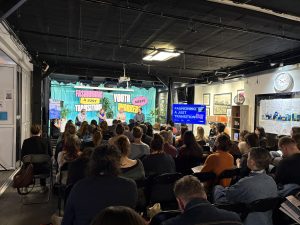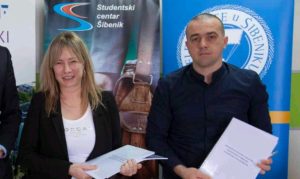
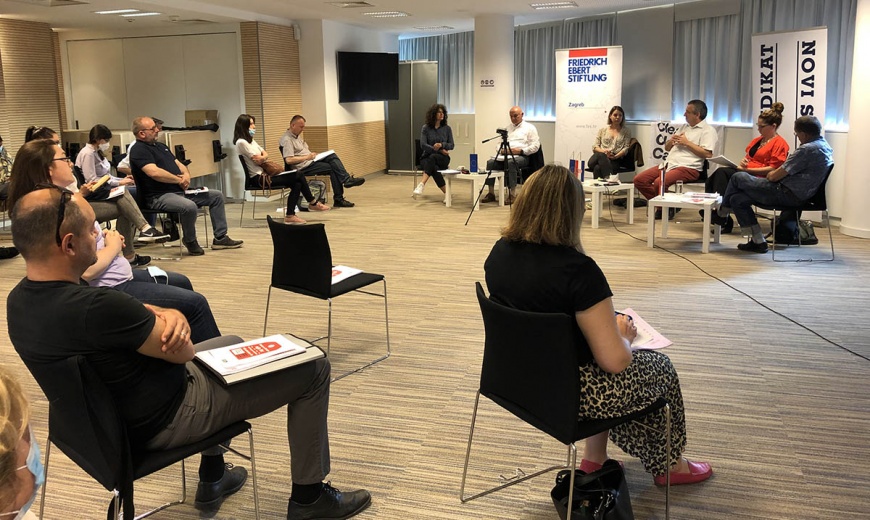
“When we talk about a living wage, we are talking about the human right to adequate working conditions,” emphasized Sandra Kasunić at the roundtable “Europe Floor Wage – A Living Wage is Possible,” held this Thursday and organized by Novi sindikat. During the event, union representatives Tomislav Kiš and Mario Iveković presented a new methodology for calculating a living wage. Alongside economist Ljubo Jurčić, Sandra Kasunić from the Centre for Peace Studies, and Ombudswoman Tena Šimonović Einwalter, they discussed the opportunities and obstacles to making a living wage our reality.
Before the start of the roundtable, Ana Vragolović presented the Fashion Checker, a tool designed to increase transparency regarding working conditions in garment factories. Through this tool, the public can learn about the labor conditions behind the brands that produce our clothes. Large companies invest heavily in their public image, presenting themselves as supporters of green policies, sustainability, and social justice. Given the power of propaganda and the influence these companies wield, the Fashion Checker serves as a welcome counterweight that helps us verify these claims. The Clean Clothes Campaign, which created the tool, seeks to influence consumers by publishing business information, based on the assumption that if people see a company treats its workers poorly, they will no longer want to buy its products. We have previously written more about this on the Radnička prava portal.
The roundtable was opened by Tomislav Kiš, General Secretary of Novi sindikat, who explained that as a union, they primarily fight for workers’ rights, dignity, and their material standing. He noted that the most important factor in securing this and the reason we sell our labor on the market is the wage itself. The question, therefore, is what does the wage that workers in Croatia receive actually allow them to do? It is often heard, and was repeated several times yesterday, that Article 56 of our Constitution states that “Every employee shall be entitled to a wage ensuring a free and decent life for himself and his family,” but the question remains: what constitutes a decent life? The Clean Clothes Campaign, of which Novi sindikat is a member, seeks to answer exactly that. Unlike the minimum wage, which is not defined by human needs but by an arbitrary statistical criterion, the logic of the living wage is reversed and starts with the question: “What does a person need to live a normal life?” Kiš points out that a person needs much more than what the current minimum wage can provide.
According to calculations, the minimum wage in Croatia in 2018 amounted to only 26% of a living wage. This means a worker in Croatia on the minimum wage earned 2,752 HRK net, while for a dignified life for themselves and their family—based on the criteria shown in the photo they should have been earning 10,452 HRK. Kiš emphasized that they are not, of course, demanding this wage overnight and are aware that such a level cannot be achieved by one country alone. Instead, the struggle for the dignity of labor must be internationalized, but they want the living wage to be set as the goal toward which we must move as a society.
“When we talk about a living wage, we are talking about the human right to adequate working conditions,” Sandra Kasunić from the Centre for Peace Studies emphasized later in the conversation, drawing attention to the fact that this is part of the UN conventions. She believes that the UN conventions ratified by Croatia are of much higher quality regarding economic and social rights than the European ones. She highlighted that a living wage, and invoking it, is not a matter of a moral imperative but a fundamental human right. Therefore, the struggle for a living wage is part of a broader fight for human rights, which are universal, indivisible, and interdependent. At the end of her presentation, she expressed the wish that all those working on improving individual rights associations, unions, institutions should form coalitions and unite their struggle as part of a whole.
Mario Iveković, President of Novi sindikat, pointed out that the situation regarding the living wage in Eastern Europe is worse than we think, often ranking below Asian countries toward which we are otherwise full of prejudice. For comparison, he noted that in Croatia, the minimum wage is less than 30% of a living wage, while in Malaysia it is over 50%, and even in China it is 45%. As an example of the degradation of workers’ status in the eastern part of the EU, he cited Bulgaria, where brands have found new ways to increase exploitation they closed factories and shifted work to households. Agents were hired to deliver materials, and the transition to this model was often presented as an improvement with the argument “now even your children can help you with the work.” The EU remains silent on this, he warned, and he encountered disbelief from MEPs who said “that cannot be possible, Bulgaria is part of the EU,” so he had to further prove the situation in Bulgaria to them.
When discussing the living wage in Croatia, he warned against inappropriate statements by high ranking politicians. The Minister of Labour, for instance, spoke about increasing the minimum wage in the context of worker dignity, which Iveković considers unacceptable given the actual amount of that wage. The goal of the living wage campaign is to introduce this concept into the public space and serious political debates, yet the only political parties that have supported the concept of a living wage over the minimum wage are Možemo! and Radnička fronta. He also commented on attempts to introduce a minimum wage at the EU level, where there is talk of a criterion that it should be 60% of the average wage. Thus, the question being asked is not what amount is needed for a dignified life, but rather about defining a percentage that would then be applied to all member states. Novi sindikat has already expressed its disagreement with this method of calculation because 60% of the average wage in Western and Northern EU is much closer to the living wage amount than is the case in Croatia. However, established unions within the EU support such a solution, and Eastern unions are too weak. “Our voice is not heard, and frankly, we don’t even have one; we are weak,” Iveković concluded.
Economist Ljubo Jurčić explained that the situation in Croatia is part of broader trends. He reflected on the global situation and warned that despite GDP growth and an increase in added value, the share of wages in GDP has been falling in recent decades. In other words, workers have seen almost nothing from this growth, while owners of capital have appropriated the surplus for themselves. He also criticized the concept of foreign investment as something that necessarily contributes to quality of life, stating that “foreign investors do not come here to raise wages in Croatia to the EU average, but for cheap labor.” He believes that shifting the responsibility for economic development to external institutions—the MMF, the EU, foreign investment is a shot in the dark and a reflection of the incompetence of Croatian governments. Globalization works such that capital seeks to produce where it is cheapest, sells where it can achieve the highest profit, and records that profit where taxes are lowest, Jurčić explains. In such a situation, the goal of economic policy should be to create quality jobs and encourage the production of products with higher added value, he concluded, offering support to unions in their fight for more dignified working conditions.
Ombudswoman Tena Šimonović Einwalter also gave her support to the living wage campaign, warning that citizens in Croatia are often unaware of the rights they have or how to exercise them. She believes that when talking about wages, it is correct to start from the aforementioned Article 56 of the Croatian Constitution, which guarantees the right to a decent wage. In Croatia, the minimum wage is received by those who are harder to employ, those over 50, women, and the less educated, and these individuals are at multiple risks of poverty. Not only are wages low, but labor rights are also frequently violated; labor-related complaints have constituted the largest number of complaints to the Ombudswoman in recent years (excluding 2020). She warned that there is a danger of the pandemic and the crisis being used as a training ground for new cuts, which will further endanger almost everyone, especially the poorest. However, her suggestions for action to prevent this scenario remained in the domain of calling on “consumer power,” which she believes we have not sufficiently realized, citing examples where young people across Europe organize boycotts of certain companies due to their business practices. In the discussion, she highlighted one positive thing in Croatia: people still have the awareness that they are entitled to certain things, and there are certain expectations regarding social and economic rights that are often not present even in more developed countries.
In his final comments, Ljubo Jurčić emphasized that it is necessary to increase the added value produced by a worker in Croatia and then distribute that added value more fairly. He sees the Government as the main actor in this, as he believes the structure of the economy is changed by policies, yet our Governments have had no policy for the last 30 years.
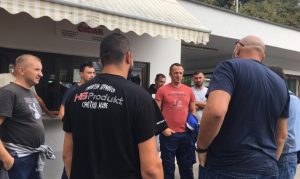
In his closing address, Iveković followed up on this, stating that the main target of their campaign and advocacy is not governments, but producers, as governments have long shown they will not solve the problem. It is important to increase pressure and force capitalists to share a portion of profits with workers. As an example, he highlighted a situation where a German company, when members of Novi sindikat who worked there went on strike, threatened to move the company to Thailand and applied other types of pressure. However, the workers continued to fight and succeeded in negotiating a 35% wage increase. The roundtable ended with a call for a joint struggle and emphasized that in this fight, we cannot rely on either the Government or the courts, but on solidarity and unity, which must also have an international character.
This text was originally published on the Radnička prava portal on June 11, 2021, under the title “Dostojanstvena plaća je ljudsko pravo.”