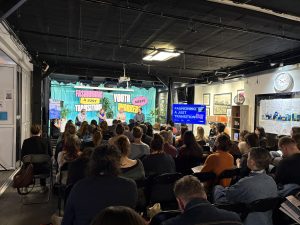
Let’s take a look behind the scenes of the first Croatian conference on gig economy, where speeches were in the foreground and talks in the second.
We are eagerly waiting for the new law – Croatia is, somewhat awkwardly, trying to follow the European directive on work through platforms, which comes into force 1. January 2024. We’re at a crossroads. This law should reshape the rules of the game, mainly by making aggregators have to become real employers and give full rights to their workers in the gig economy. The draft law echoes the hallways of the conference, bearing the promise of a new era in which workers could finally see their rights enshrined in law, not lost in translation.
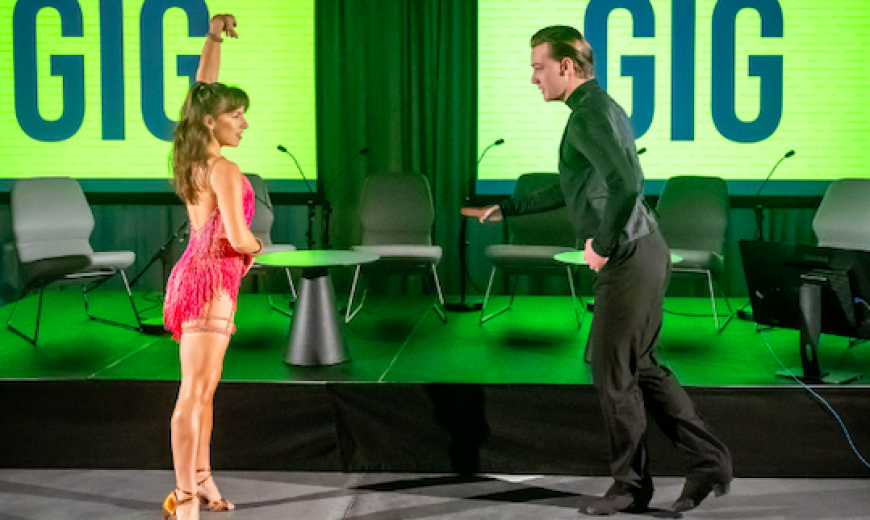
But, while Communication laboratory d.o.o. gathering applause for the organization of this event, the audience was surprised by an unexpected introduction – dance point. Indeed, nothing radiates the” seriousness of economic discourse ” as pirouette and tango after the introduction of Ida Prester.
This dance introduction was just a foreplay for the real show of the day – a series of monologues pretending to be dialogue. As the panels unfolded, we-uninvited but self-appointed representatives of the workers – witnessed a series of presentations with no opportunity to ask questions. There was no set time for Q & A, it all came down to one-way speeches. Panelists treated themselves to their meals, while workers remained thirsty for answers. It seemed as if the organizers had carefully avoided a real exchange of views.
But we won’t beat around the bush. All who are “someone and something” in the gig economy world were there, except those” some ” that actually work. The neo-liberal economist Vedrana Pribičević, known for her comments on the account of CHF loan debtors, she shared the stage with the likes of Irene Weber and an enthusiastic Uber manager, Morena Šimatić. We must not forget Drago Cota from Glova and Ivan Jarnek, our favorite aggregator, all under the guidance of charismatic Ida Prester as moderator.
While the panelists debated, Dražen Opalić introduced a new law, which was already under criticism for not meeting the directive’s expectations. However, Opalić managed to draw an interesting parallel between gig workers and the precarious ones, pointing out that in Europe the focus should be on social justice, not on profits placed above people, as is often the case with the American approach that Vedrna Pribičević considers a model. Opalić emphasized that our goal is not to copy the American model, but to create a system in which social justice forms the basis of the labor market. This was the moment when the speech seemed to go beyond the usual economic jargon, touching on core values that many felt the gig economy was neglecting.
But despite this flash of social justice, the questions remained unanswered, and we remain with the bitterness of espresso at the break of the conference: How will aggregators secure paid leave or sick leave when their profits are based on commissions? What happens when workers don’t work? At lunch break, we asked the question to the poster-the aggregator boy – after he praised the question, Ivan Jarnec, as he says, thought about “some kind of fund”. This vague idea foreshadows a future where workers could be forced to pay more to fund that fund – a future where the gig economy melody could end up as a swan song for smaller aggregators. As these entrepreneurs face financial pressure, their workers could be left without pay, with pockets full of empty promises of change.
This question hung in the air, even after we referred it to Josipa Klišanin from the Labor Department. Her response was a rehearsed step,” the ministry will do everything it can to avoid it, ” before she went to lunch with the panelists – leaving us with a bunch of worries and no solution.
Fabijan Popović from Bolt also had his moment under the spotlight about Bolt’s contribution to the Croatian economy, while the screens showed satisfaction statistics of GIG workers, whose source was not indicated. However, peer-reviewed studies they show a different image-nuanced and far from the monochrome presentation on stage.
While media reports repeated Vedrana’s claim that gig economy is a “fantastic new freedom”, we couldn’t help but wonder whose freedom it was. Certainly not a worker like Jurica Ćutuk, who mistook the known (state job) for the unknown (delivery in gig Economy). His family’s shock was a small price to pay for the” freedom ” he now enjoys – a freedom that in this case means sailing on waves of uncertainty for pay. This job, he says, he plans to work for another year. But may he be pleased with us.
Here, it was a gig economy conference, where the show ended, and the workers were left empty-handed. We applaud their courage, admire their irony, and ask the question – When will workers finally get their rightful place at the table? Until then, we write a satire that writes itself.
#FutureProofCollectiveBargaining #PlatformWork #EuropeanDirectiveOnGigEconomy #GigEconomyConference #CroatianLabourLaw #SocialJusticeInLabour #GigWorkersRights #MonologuesOverDialogues #Thegigisup the gigconference . # gig #Europeandirectivesagigeconomies # Konferencijagigeconomies # Hrvatskazonorada # Socijalna Pravdaurada # Pravaradnikagigeconomies # Monoloziumsdialoga