This year, the Clean Clothes Campaign (CCC), an international network fighting for the rights of textile workers, is marking Living Wage Day for the first time. CCC members are organizing actions in more than 30 countries, and the global action in Croatia is joined by the Coalition for a Living Wage.
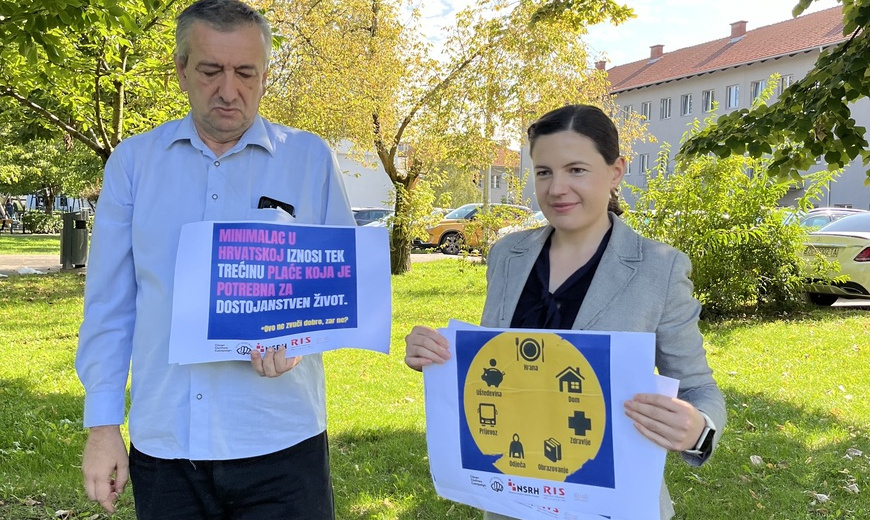
At a press conference held in front of the Novi sindikat office (Park Stara Trešnjevka 2) today at 11 a.m., Marina Palčić, President of the Independent Trade Union of Croatian Workers, stated that “a living wage is not just a question of money, but a question of the rights and dignity of every worker in our country.”
“During every tourist season, we have the opportunity to see visitors from all over the world come to our country—people who are workers in their own countries but are able to afford a holiday for themselves and their families on our beautiful shores and in our cities. At the same time, our workers cannot afford even a short vacation within their own country.
A living wage is not only about survival; it is about the possibility for a worker and their family to have a life worthy of a human being—to be able to travel, create memories, and have access to cultural and social content. By ensuring a living wage, we not only ensure a better life for every worker but also strengthen our economy. When people have more money, they spend it in local communities—in restaurants, shops, and on trips within the country. It is a cycle that benefits everyone.” said Palčić.
A living wage is guaranteed by Article 56 of the Constitution of the Republic of Croatia. However, the “right to a wage by which every employee can ensure a free and dignified life for themselves and their family” is generally ignored, especially in the textile industry. Textile workers in Croatia earn a minimum wage, which amounts to only a third of what is considered a living wage. In other countries, they sometimes earn even less than the legal minimum.
Mario Iveković, President of Novi sindikat, stated that the Clean Clothes Campaign (CCC) calculated living wages according to a methodology that puts workers and their essential costs—primarily food—at the forefront.
From 2016 to 2019, field surveys of “food baskets” were conducted in five countries (Albania, North Macedonia, Ukraine, Hungary, and Moldova). Through further calculations, a living wage benchmark was established for 15 European countries.
“As data becomes obsolete rapidly, we updated the figures for 2021 and 2023 by adding inflation for each year to the initial 2018 amounts. The calculation showed that a living wage in Croatia for 2023 was 1,727 euros, while the minimum wage was only 560 euros net. The ratio remains the same as in 2018: the wage workers actually earn is three times lower than a living wage,” Iveković said, adding that for 2024, with added inflation, a living wage would amount to approximately 1,800 euros.
However, it should be noted that these updates did not fully account for the specific surge in food costs, which requires new field research. Novi sindikat will conduct this research. Over the next three years, a study on the working and living conditions of textile workers is planned across six countries, and it has already begun in Croatia.