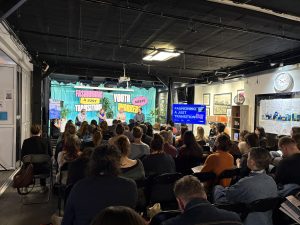
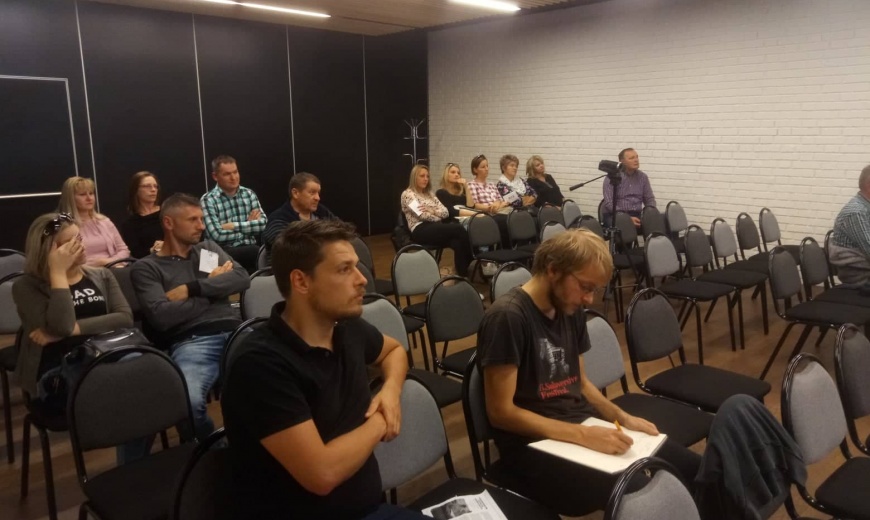
On Saturday, 12.10., a panel discussion titled “Organizing for Better Working Conditions” was held in Varaždin, organized by the Croatian Centre for Workers’ Solidarity (HCRS) and the Regional Industrial Union (RIS). Štefica Pale-Valjak, former employee of Zelinka and DTR; Siniša Miličić, president of RIS; and Tomislav Kiš, general secretary of Novi sindikat, spoke at the panel. The topic of the discussion was the organization and possibilities of struggle in the textile and related industries.
Speakers highlighted some problems that make union organizing difficult. Very often, people do not believe in unions and think they are corrupt, but in doing so, they forget that they themselves constitute the union. “It is a mistake to expect the union to solve your problems without getting involved yourself. My job is to teach you and provide the legal framework and organizational tools to fight for yourself,” said Tomislav Kiš of the Novi sindikat.
He added that the union is neither its leadership nor its legal team if there are no workers: “Our whole professional team, without people to support us and tell us what to do, is nothing. A group of workers in a company without an organization are just employees. It is only when these two elements come together that a true organization emerges.”
Kiš and Štefica Pale-Valjak also emphasized the importance of workers’ actions being guided by harmony, persistence, and courage. During the strike at the domestic laundry factory (DTR), visibility was an issue because the plant was in Brckovljani, 30 km from Zagreb, where journalists would not come. Therefore, when reporting the strike, Novi sindikat announced it would be held at all the employer’s premises, including shops in central Zagreb. This strategy successfully drew attention and revealed who the director was. “Because of good organization, we managed to achieve everything that the workers asked for, and the final severance payments were made a few days later. They fought because they were organized into an organization that knew how to act,” Kiš said.
One potential reason why workers hesitate to organize is threats from employers to relocate production to cheaper locations if wages increase. Siniša Miličić compared gross minimum wages in Croatia and Slovenia. The minimum wage in Croatia is 3,750 HRK, while in Slovenia it is about 6,500 HRK. He connected this to Boxmark, which has factories in Varaždin and Kidričevo (approximately 100 km apart), showing that claims of “no room for salary increases” are untrue.
Miličić presented a table of salaries in the textile, leather, and footwear industries, showing that average net salaries are between 3,500 and 4,500 HRK, but actual take-home pay is often lower because the average includes salaries of directors and other higher-level positions.
Kiš argued that there is no lack of money in Croatian textile factories, but the real money is at the brand centers – in Italy, Spain, Germany – and certainly in the global textile industry. Brand owners are among the richest people in the world. He cited an example of a Bulgarian worker who sews moccasins at home for a famous brand, earning ten lipa per pair, while the shoes retail for 168 euros. Therefore, he advocates pressuring brands to increase labor costs in product prices and building international solidarity, because capital has no boundaries. Organizations like the Clean Clothes Campaign (CCC), which fight for workers’ rights in the textile industry, can provide important support. The CCC also promotes the concept of a decent wage – one that allows a family with two children to cover all living expenses.
In conclusion, steps toward better working conditions include organizing into experienced combat unions, building national and international networks, and directing pressure toward the large multinational companies that control most of the fashion industry.