
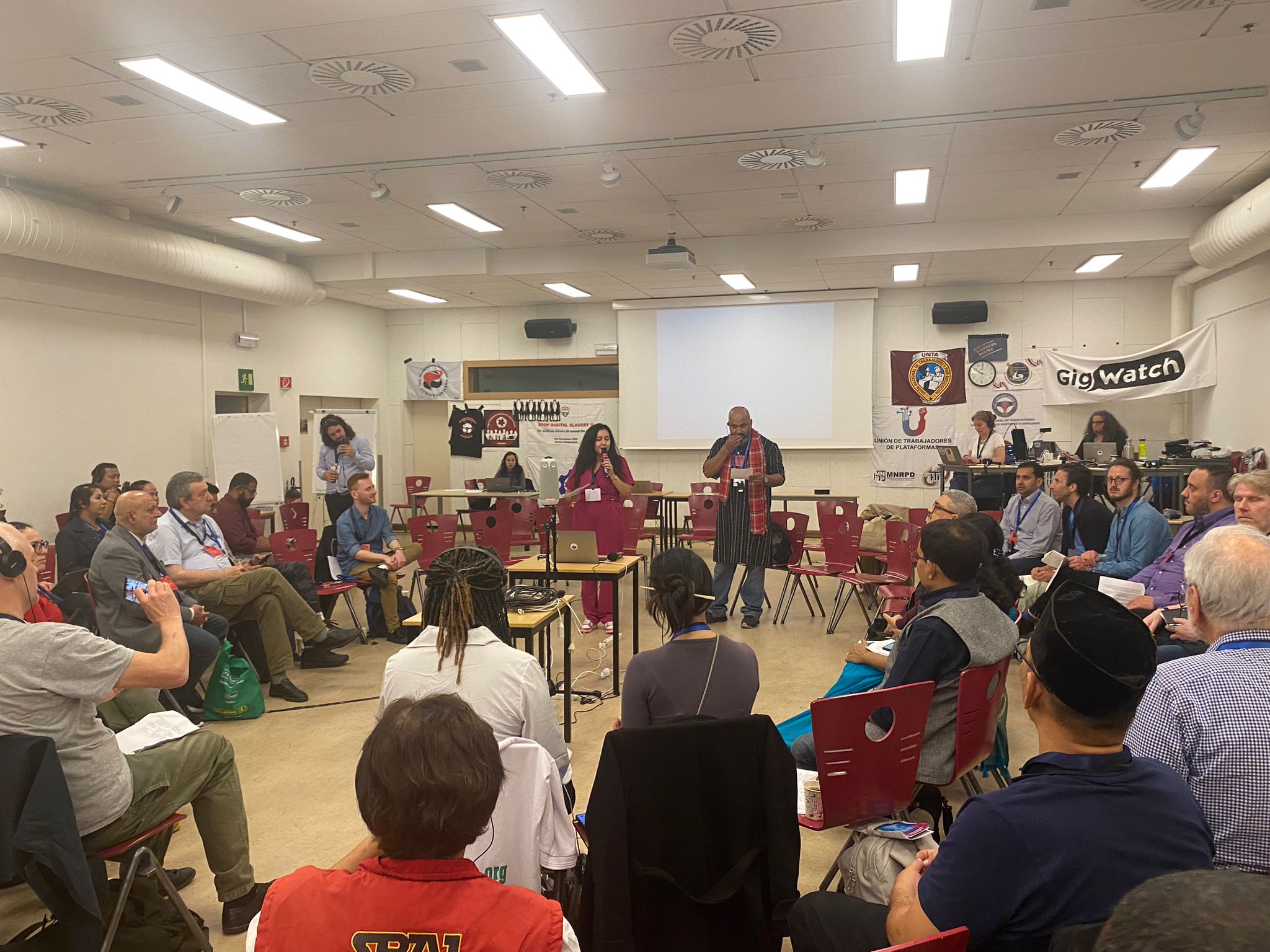
From 3 to 5 June 2025, President of Novi sindikat, Mario Iveković, participated in the 113th International Labour Conference in Geneva, titled this year ‘Gig Workers United.’ Conference participants discussed ways to improve the working conditions of platform workers.
Governments and employers’ representatives at the International Labour Organization (ILO) Conference should support a new agreement to protect gig, i.e., platform workers, according to 33 civil society groups, trade unions, and human rights organizations. The group participating in the Conference issued a joint declaration on the second day of the session.
The group highlighted the urgent need to address critical gaps in occupational safety within the platform economy, where companies recruit workers to perform jobs, or ‘gigs,’ through apps or websites. Platform workers often face misclassification of jobs, low and fluctuating incomes, lack of social security, and barriers to unionization, while being monitored and managed by non-transparent and irresponsible algorithmic systems. The adoption of the ILO Convention and its accompanying guidelines is essential to protecting the rights of platform workers.
‘Platform companies are benefiting enormously from a business model that deprives workers of their rights,’ said Lena Simet, a senior economic justice researcher and advocate for Human Rights Watch. ‘Adopting the Convention and guidelines would send a strong signal that technological change should not come at the expense of human rights.
The group emphasized in the declaration that employers should not misclassify platform workers as independent contractors, as this denies them rights to minimum wage protection, freedom of association and collective bargaining, and social security. In many cases, platform employees do not even have human supervisors and are subjected to vague decisions made by automated algorithms, further undermining their job security and working conditions.
Currently, there are no binding international laws that explicitly address the working conditions of platform workers, although international human rights law affirms the protections to which all workers are entitled. The ILO has the opportunity to ensure that platform workers, a significant and growing segment of the workforce, can fully exercise their rights.
The proposed international standards should recognize waiting periods as working hours, establish clear criteria to prevent covert employment relationships, and create effective appeal mechanisms and access to remedies for workers harmed by algorithmic management.
“Employees on the platform face insecurity, low wages, and are excluded from social security, while companies earn billions,” said Isabel Ortiz, Director of Global Social Justice. “Binding ILO standards are essential to ensure that these workers have decent jobs and are included in social security systems. Some countries have demonstrated that this can be done; now it must happen everywhere.”
Negotiations on new standards are currently underway at the International Labour Conference. Discussions on scope and content are expected to conclude at the 114th meeting in 2026, when the final document will be officially adopted, if member states and representatives of employers and workers reach an agreement.
This article was originally published on the: Human Rights Watch.