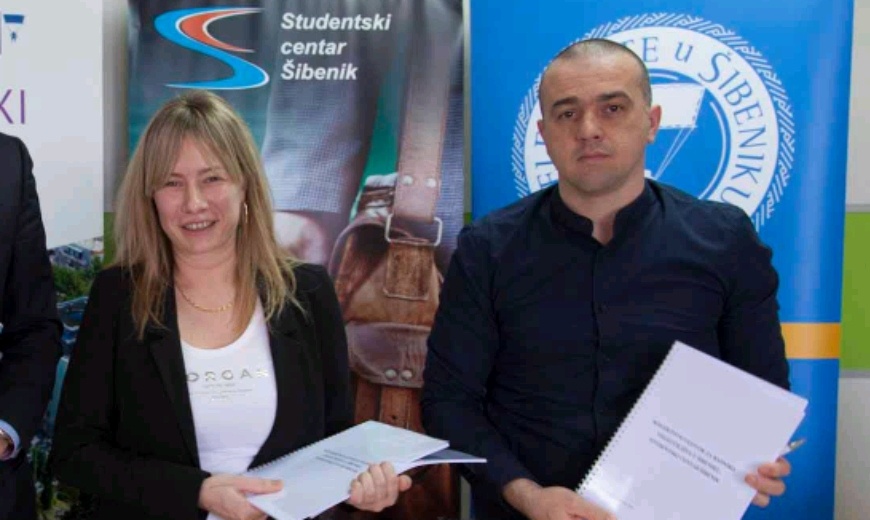
The Student Center in Šibenik has made a significant step forward with the signing of its collective agreement, reflecting progress over the past few years since the opening of the student restaurant. Since then, the number of employees has increased to 18, and with the opening of the new student dormitory, this number is expected to rise to over 30. From a small organization, the Student Center is growing, and as the administration, we felt it was necessary to better regulate employees’ material rights because the scope of work and the revenues of the Student Center have changed. We recognized an opportunity to improve workers’ benefits, with the goal of enhancing the quality of services provided to students. A consensus on workers’ material rights led to the conclusion of this collective agreement.
“The substantive collective agreement for employees provides more favorable material rights, which will result in greater work enthusiasm and more comprehensive service,” said Ivan Malenica, Dean of Šibenik Polytechnic and head of the Governing Council of the Student Center.
The collective negotiations, which lasted one and a half years, involved representatives of the Student Center, Novi sindikat and the Independent Union of Employees of Student Centers of the Republic of Croatia. Trade unionists had announced a strike in mid-November, but Marijana Vrančić, Union Commissioner of the Šibenik branch of the Independent Union of Student Center Employees, stated that common ground had been found with SC management.
“When negotiations stalled, we reacted, but we eventually found common ground and reached an agreement satisfactory to both sides. We are pleased with the collective agreement. Since a large investment is planned in the Student Center, we knew some concessions would be necessary, and I believe we have found a golden mean that satisfies both parties,” Vrančić said.
Nikola Kutleša, Commissioner of the Independent Union of Student Center Employees branch, noted that this is the first collective agreement at the Šibenik Student Center, which contributed to longer negotiations. He expressed hope that this agreement would serve as a catalyst for future improvements.
“Šibenik has made progress in material rights; salaries were raised, annual vacation issues were addressed, and wages increased by 15 percent. If the state salary base increases, these salaries will also be adjusted. Šibenik previously had some of the lowest salaries among student centers in Croatia, so any increase was welcome. Most employees in student centers work in catering, and there is a shortage of personnel in this area. These salaries should improve further, which time will show, given the shortage of chefs and waitstaff, who make up the majority of student center employees,” Kutleša said.
Before the collective agreement, the lowest average salary for a chef was slightly below 4,000 kuna, while the SC director earned around 7,500 kuna. There are 18 employees at the Šibenik Student Center, 14 of whom are union members. The collective agreement applies to all employees and is valid for two years.
Tomislav Kiš, General Secretary of Novi sindikat who assisted with the negotiations, highlighted that the most important provision of the contract ensures wages can no longer be raised or lowered without employees’ knowledge.
“The key point is that the collective agreement represents progress. I do not like that the previous situation is referred to as rebellion, because everything was resolved and agreed upon reasonably. The systematization of wages is now an integral part of the collective agreement, and management can no longer adjust wages without workers’ knowledge,” Kiš said.
Darija Šare, who became Acting Director two weeks ago after Nella Slavica moved to head Krka National Park, praised the agreement.
“The collective agreement is excellent because respecting workers’ dignity is a moral obligation for every employer, and that is why we signed it,” said Acting Director Darija Šare.