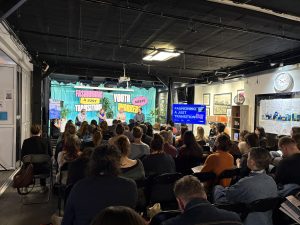
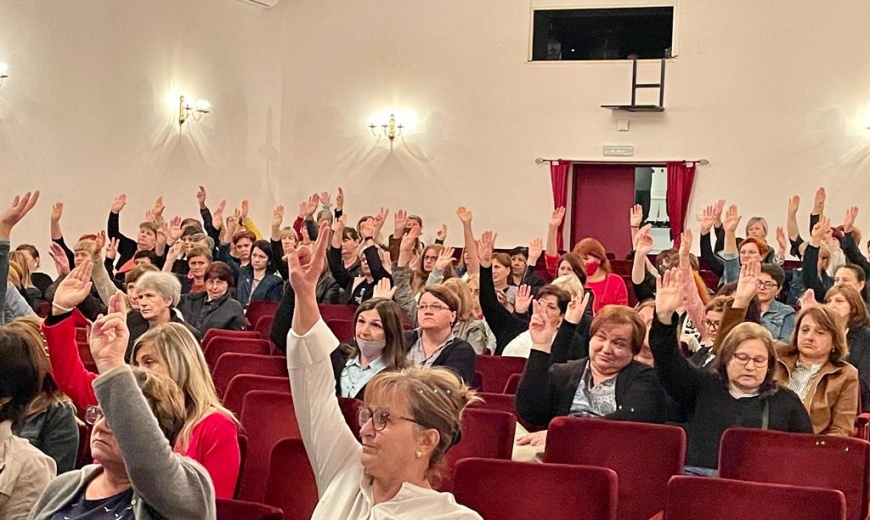
The workers of Orljava gathered on Monday, September 20, at the Požega City Theater to send a message to the Government and Olymp. They addressed those responsible for the destruction of the factory where they worked for years, stating that they will continue to fight to save jobs and restart production. Ana Vragolović attended the meeting, which was organized by Novi sindikat in cooperation with the Union of Textiles, Leather, and Footwear of Croatia and the Clean Clothes Campaign.
The Orljava factory in Požega has been in bankruptcy since mid-July, when 172 workers were dismissed. After a one-month notice period, they registered as unemployed. According to the official explanation, Orljava entered bankruptcy due to a 30 million HRK debt to banks and the Tax Administration, as well as an inability to pay salaries. At the time of bankruptcy, the factory owed workers three months of minimum wages, which were subsequently paid by the Agency for the Insurance of Workers’ Claims.
The workers are currently facing uncertainty. Many are only a few years away from retirement, but most employers are reluctant to hire older women. Even without that factor, there are almost no jobs in Požega where they could work until retirement. Currently, some find occasional work harvesting grapes, but permanent positions are non-existent.
The workers want production to continue. Beyond their own livelihoods, there is the question of what will happen to students at the Požega Vocational School, who will have nowhere to perform their practical training or find employment afterward. However, new orders are required to sustain production.
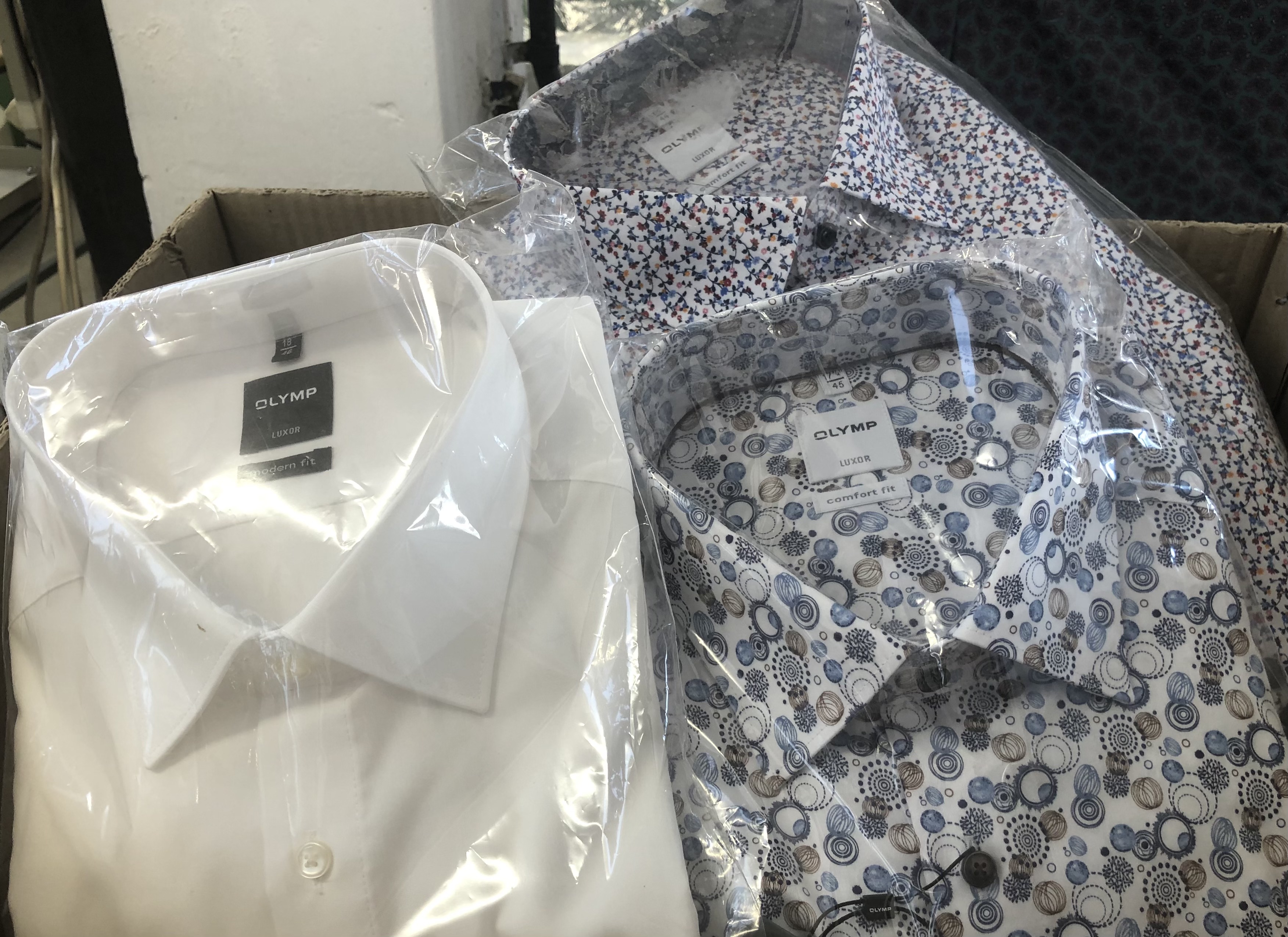
For more than 50 years, the main client for Orljava’s shirts was the German fashion brand Olymp, which accounted for over 80 percent of orders. Olymp even had an exclusivity agreement with Orljava, meaning the factory was not allowed to sew for other companies. At the start of the pandemic, Olymp began reducing orders until they were canceled completely. Gradually, about a hundred temporary employees lost their jobs as their contracts were not extended.
Responsibility for the collapse also lies with the state, which owns Orljava. At one time, the state ordered large quantities of uniforms but eventually transferred that work to a private company from Đakovo. The Ministry of Physical Planning, Construction, and State Assets remains passive and has not reacted to the difficult situation of the workers.
To send a message to the Government and Olymp, the workers gathered on September 20, 2021. The meeting was organized by Novi sindikat in cooperation with the Union of Textiles, Leather, and Footwear of Croatia. In addition to the workers’ meeting, the goal was to connect textile workers with representatives of the Clean Clothes Campaign (CCC), an international initiative active since 1989 that brings together over 200 unions and organizations dedicated to improving working conditions and empowering workers.
After union representatives informed the workers about the bankruptcy proceedings and the filing of claims, CCC representatives spoke. Artemis Ljarja, coordinator of the Urgent Appeals system and member of the German Clean Clothes Campaign coalition, contacted the workers first. She was followed by Miriam Saage-Maaß, a lawyer at the European Center for Constitutional and Human Rights (ECCHR), and Maren Leifker, a human rights advisor from Bread for the World.
They stated that the Clean Clothes Campaign and their individual organizations are ready to provide necessary support. They emphasized that Olymp, as the main buyer, is responsible for the factory and the workers. Therefore, they believe Olymp is obliged to pay the severance pay that the state insurance agency will not cover. Additionally, they stated that Olymp paid a shamefully low price for the shirts, which is likely why the factory operated at a loss.
Lawyer Miriam Saage-Maaß pointed out that the ECCHR is working on a law to regulate the obligations of German companies across their entire supply chain (the Supply Chain Due Diligence Act). Once adopted, German companies will be held responsible in German courts for labor rights violations anywhere in the world where they produce. This also means potential legal support for workers in cases like Orljava.
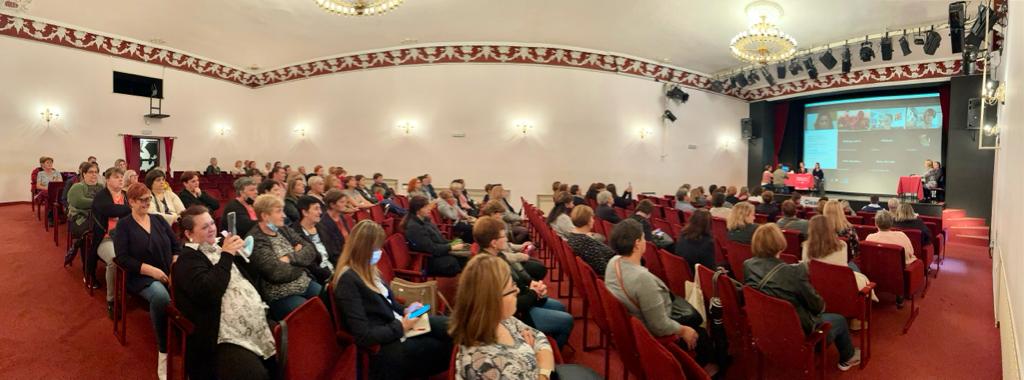
Orljava workers gathered, photo: Vivien Tauchmann/CCC Germany
In addition to legal support, the Clean Clothes Campaign is ready to support workers through social media campaigns and public solidarity actions. Members demonstrated this online, where various organizations showed support: the Center for Emancipation Policies from Serbia, the union representative of the Valy factory in Valjevo, and organizations from Albania, Great Britain, Belgium, Pakistan, and other countries. Participants displayed messages such as: “Olymp & Government of the Republic of Croatia, return the workers to work,” “Solidarity with the workers of Orljava,” and “Pay severance to the workers.”
Helen Zitzelsberger from Olymp’s Corporate Responsibility Department joined the online call but did not speak. The bankruptcy trustee, Krešimir Tomac, did not attend the meeting despite being invited.
The meeting concluded with a restatement of the workers’ demands. Olymp and the Government must ensure the continuation of production so workers can return to their jobs with better wages, rather than the minimum wage on which they can barely survive. The workers are asking for 60 percent of a living wage, calculated from a base of 10,400 HRK. Furthermore, Olymp and the Government should pay the workers the five out of eight severance payments owed to them under the collective agreement. The state agency will pay three minimum gross installments, but there are no funds for the remaining five. Therefore, those responsible for Orljava’s situation must take responsibility.
Orljava is another in a series of intentionally destroyed factories in the textile and clothing industry, which has been reduced to 23,000 workers. Without production, Croatia cannot develop, and more people will emigrate. That is why it is vital to support Orljava workers in their fight to preserve jobs.
.jpg)
Support for Orljava workers came from a number of countries, photo: Vivien Tauchmann/CCC Germany
Author of the cover photo: Vivien Tauchmann/CCC Germany
The text was originally published On the Workers’ Rights portal 9/24/2021.