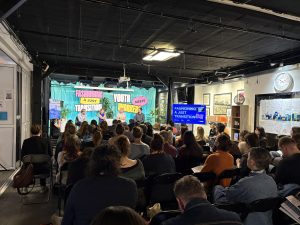
The Coalition for Dignified Wages presented the European Citizen’s Initiative and commented on the European Commission Directive on corporate responsibility. They also addressed the government measures aimed at mitigating the growth of energy prices.
The coalition for a dignified salary, consisting of several non-governmental organizations and three trade unions, held a press conference yesterday, March 23, in front of the Novi sindikat office in Zagreb. The purpose of the press conference was to present the European Citizens’ Initiative for a living wage Representatives of the coalition also commented on other important topics, including the recently published European Commission Directive on Corporate Responsibility and the Croatian Government’s measures to mitigate price growth caused by rising energy costs.
First, Sandra Kasunic from the Center for Peace Studies explained what a living wage is and why it is important for the Government of the Republic of Croatia to take steps to reach this level: “A living wage means that we can afford an adequate and high-quality standard of living. It means we can afford to pay for all regular living expenses, it allows us to cover unexpected expenses, and it must also provide for savings.”
She then pointed out that, despite being a basic human right defined in the Constitution of the Republic of Croatia, a living wage for a large part of workers is not a reality. Novi sindikat, as part of the Clean Clothes Campaign an international network of organizations fighting for workers’ rights in the textile industry presented a calculation methodology and the amount of a living wage for Croatia last June.
“The calculation was done before the price increases and inflation, which creates concerns for all of us. The minimum wage for 2022 will cover only one-third of a living wage,” Kasunic pointed out. She appealed for the Government of the Republic of Croatia to protect the socio economic rights of all workers and to adopt policies that will gradually guarantee the implementation of a living wage.
Nikola Ptić, secretary of the Regional Industrial Union (RIS), followed up on the topic with examples from trade union practice. He stated that in his work with RIS, he mostly encounters low wage workers employed in public transport, the metal industry, footwear production, and other sectors.
Their wages remain well below average, leaving them constantly on the edge of poverty. Rising prices and the increasing cost of living will only put more pressure on them. This happens when the workers’ voice in the workplace is silenced and their access to decision making is restricted. Collective bargaining as a practical mechanism is difficult to implement and is often blocked by employers, Ptic explained.
He then described the situation of personal assistants for persons with disabilities. These are workers who assist people with disabilities, essentially acting as their hands and feet. Their work is physically and mentally demanding, highly responsible, and socially vital. However, most assistants work part time for a salary of 2,000 HRK, while those working full time receive 4,000 HRK wages that are far from a living wage.
As another example, he cited employees in companies providing customer support for large corporations, such as call centers. Most of these employees also work for the minimum wage, with any potential salary increases depending on various bonuses entirely at the employer’s discretion bonuses that can easily be abolished or reduced.
On one hand, we have underpaid, neglected, and undervalued workers funded by public resources, and on the other, private-sector workers employed by companies that generate massive profits while seeking cheap labor worldwide. At the same time, there are no mechanisms to hold these corporations accountable; there is no corporate responsibility framework that would force them to ensure a living wage for all workers in their supply chain, Ptic concluded, before announcing a potential solution.
Mario Ivekovic, president of Novi Sindikat, spoke about how to change the current situation and how to hold corporations accountable.
He stated that the Coalition for a Living Wage first spoke out during discussions on the European Directive on Adequate Minimum Wages, amendments to the Minimum Wage Act, and changes to the Labor Law. At that time, while calculating the living wage, the coalition noted that this is what every worker should be entitled to. Consequently, the coalition called on the Government to set the living wage as a primary goal.
“The first draft of the Corporate Sustainability Due Diligence Directive supports the coalition’s efforts,” Ivekovic pointed out. “Large corporations, which are often the underlying cause of low wages, will be required to respect workers’ rights not only in their own subsidiaries but throughout their entire supply chains. The Directive applies to corporations with more than 500 employees and an annual turnover exceeding 150 million euros.”
He also noted that once the Directive enters into force, companies that previously boasted about respecting human rights through self-conducted audits will no longer be able to evade responsibility so easily.
“The auditors used to tell them: ‘You pay wages on time, and that is enough.’ But no one cared about the amount of that wage or whether a person could actually survive on it. What does the Constitution say? Our government will likely monitor the payment of the minimum wage, but we will insist on the payment of a living wage. This is supported by the annex of the Directive, which refers to a living wage rather than just a minimum wage,” Ivekovic concluded.
Finally, representatives of the Coalition for a Living Wage announced their participation in the European Citizens’ Initiative (ECI) for a living wage. The ECI is an instrument of participatory democracy in the European Union that allows citizens to propose new legislation.
Despite being a fundamental human right defined by the Constitution of the Republic of Croatia, a living wage remains out of reach for many workers. The European Citizens’ Initiative for a Living Wage Directive, titled “Good Clothes, Fair Pay,” is led by the global fashion reform movement Fashion Revolution, with the Clean Clothes Campaign as a key member. Both networks are dedicated to improving rights within the garment sector. Consequently, the directive they are seeking through this initiative focuses on the textile industry one of the most labor intensive and lowest-paid industries.
The European Union is the world’s largest single market and the leading importer of apparel, with over 69 billion euros worth of clothing imported in 2020 alone. “As the largest single market, the EU has a responsibility to ensure that the clothing sold within its borders is produced in safe conditions and that the people making these clothes are paid fairly,” the initiative’s website states.
“Since global garment supply chains cross national borders, legislation must do the same,” representatives of the initiative point out. This is why they are seeking a directive applicable to the entire European Union only such a framework can ensure that companies monitor their supply chains effectively. Furthermore, the proposed Directive would apply not only to companies producing within the EU but to any company selling products in the European Union, regardless of where they are manufactured.
The initiative targets fashion companies and brands with global production networks, particularly in regions where wages are lowest, including Croatia. Brands such as the Italian Benetton and Calzedonia, and the Austrian Boxmark, as well as luxury labels, produce here; until recently, this also included Hugo Boss and Olymp.
These brands typically do not own the factories themselves; instead, the system operates through outsourcing. For example, Benetton produces in Croatia, Serbia, Romania, Moldova, Ukraine, Turkey, Egypt, India, China, and numerous other countries. The parent company itself employs only about five hundred people, mostly managers, designers, and high ranking staff.
Under this system, fashion brands often shift the blame for the lack of a living wage onto their suppliers. However, it is the brands themselves that place the orders and set the prices prices that often barely cover the basic cost of production.
For example, the German brand Olymp paid the Požega-based factory Orljava approximately 4 euros per shirt a price that barely covered the bare minimum. This is one of the reasons the factory went bankrupt in July 2021. The workers hold both the Croatian Government (as the factory owner) and Olymp (as the largest and exclusive customer) responsible, they are still seeking the severance payments they are owed from both parties.
While closing factories in one country and leaving workers unemployed, Olymp continues to sell shirts elsewhere for at least 100–150 euros. Consequently, the “Good Clothes, Fair Pay” initiative maintains that fashion brands are the root cause of low wages and must take responsibility for human rights within their supply chains. They should be legally obligated to pay suppliers enough to ensure a living wage for all workers.
The proposed European Citizens’ Initiative (ECI) for a Living Wage Directive complements the previously mentioned European Commission Directive on Corporate Sustainability. However, there are key differences. While the Commission’s Directive applies to all industries, the ECI focuses specifically on the textile sector with more ambitious goals. The Commission’s proposal targets companies in high risk sectors with over 250 employees (not 25) and a 40 million euro turnover; in contrast, the ECI Directive would cover all companies in the textile, clothing, leather, and footwear sectors that produce for or sell on the EU market.
Signature collection for the ECI Living Wage Directive began in May 2022. The Coalition for a Living Wage announced it will collect signatures at various locations in Zagreb and online. If one million signatures are gathered, the initiative will formally request that the European Commission adopt their proposal.
“If we achieve this in the lowest-paid industry, this right will inevitably have to be extended to all other sectors,” representatives of the Coalition concluded at yesterday’s press conference
The text was originally published on the H-Alter portal March 24, 2022.