What is Clean Clothes?
Clean Clothes is a global network of associations, trade unions, and individuals working to reduce disparities in working conditions worldwide. The campaign primarily focuses on workers in the lowest-paid industries—textiles, footwear, and recently toys—in countries with intensive production, mostly in Asia. By supporting workers in the most difficult conditions, the campaign aims to raise labor standards globally and prevent the relocation of industries that exploit cheap labor to maximize profits.
Clean Clothes operates through awareness campaigns in consumer countries, pressuring producers to improve working conditions and wages. This includes actions such as boycotts in extreme cases. Trade unions in companies, including their subcontractors, actively participate, advocating for freedom of association, living wages, health and safety at work, and access to fair judicial protection.
How and why Novi sindikat got involved?
Novi sindikat joined Clean Clothes about ten years ago when the campaign began expanding its focus to the countries of Eastern Europe. Unfortunately, in Croatia, the textile industry has almost disappeared, but it is alive in this region: Bulgaria and Romania are real El Dorados, there is some of it in Bosnia, Macedonia, Albania, and in recent years the footwear industry has started returning to Serbia… Salaries are relatively low, and the situation is not as great as we would expect. In Bulgaria, for example, there is a real problem with home-based workers – manufacturers have closed factories so that workers would take the work home and thus slash the cost of labor by half, if not more – things that are hard to imagine in a country of the European Union. In short, as all union work rests on the idea of solidarity, we liked the idea immediately, as well as the concept of providing support to workers in production countries through civil society. We immediately became involved in research on the state of the textile industry in Eastern Europe.
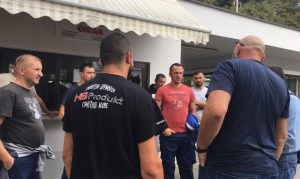
We are currently planning new activities in Macedonia and Bulgaria to strengthen the campaign’s capacities and provide the most effective support possible to workers. Recently, as part of an international delegation, we went to determine the situation on the ground at an Italian footwear manufacturer with a factory in Serbia – it concerned a ban on union organizing and truly unacceptable working conditions in which workers were not allowed to go to the toilet during working hours. Following our visit, an invitation for a meeting arrived from the headquarters via the Italian Clean Clothes campaign. We are glad that our work has been recognized and that through the Clean Clothes campaign, we have the opportunity to promote the values of the labor movement.
Clean Clothes Advocacy on Global Supply chains
Global supply chains have been one of the most important topics Clean Clothes has dealt with over the past 15 years. Between a store in a consumer country and a factory in Bangladesh, there is an entire logistical chain – we realized we can achieve a lot if we track it. The idea of the Clean Clothes campaign is to include a minimum of rights for all workers participating in the supply chain into global collective agreements. Clean Clothes cooperates with global unions (IndustriALL, UNI Global Union) in concluding such agreements. Several brands have already signed them, but their implementation, according to experiences from India, is very difficult. However, things are moving. This year, following a conference to which representatives of the Clean Clothes campaign were invited, the International Labour Organization issued a resolution for the first time encouraging employers to engage in cross-border bargaining. Until now, globalization has applied to everyone except workers and unions – while capital crosses borders without issue, for us, they remain closed. In the prices on the Western market, there is room for both better working conditions and higher salaries in Croatia: the space for negotiating the price of labor is closed when the management of a company with owners in Germany agrees on a minimum product price. The situation would be significantly different if negotiations were conducted directly with the owners in Germany.
Priority of the Clean Clothes campaign – living wages
Differences in working conditions on a global level have already decreased – there are indicators that point to this. Before Clean Clothes began its operations in Asia, there were countries where no minimum wage was defined. Today, almost all countries have a minimum wage requirement, and specific campaigns are being conducted for a living wage – a wage one can live on decently, or a livin wage.
A living wage is a human right guaranteed across Europe by constitutions and international documents (e.g., the European Social Charter). In practice, a living wage does not exist; instead, the minimum wage is used as a benchmark – an administratively determined pittance that serves more as protection for the employer against unfair competition than it approaches a living wage, which by definition should be sufficient to support an entire family. Much has been achieved in this regard in Asia by the Clean Clothes campaign and their unions, which we should look up to – in Malaysia, the percentage of the minimum wage within a living wage is 56%, and workers in China are very close to 50%. Croatia, at 38%, ranks relatively well in Eastern Europe, but it is an alarming fact that the situation 10 years ago was drastically different. The topic of a living wage is one where we certainly have work to do in Croatia, starting with the development of a methodology that would even enable the living wage to be measured, since it is already a category in the Constitution.
What can employers do to protect human and labor rights?
A living wage is an area where the business sector can certainly have a direct influence. A major role in this regard in Asia was played by the multi-stakeholder coalition Asia Floor Wage, in which employers participated alongside local authorities, unions, and associations—everyone realized that the situation was not good and that the exploitation of workers leads nowhere. Synergy is the only solution, and synergy always produces results. No union can resolve anything without the employer, and no employer can without the government. In our country, unfortunately, the problem lies in damaged relationships. At the Economic and Social Council, you can only hear dissonant tones—the Government wants to implement its own agenda, the unions want to increase the minimum wage, and the employer invokes competitiveness. However, competitiveness cannot be built by violating one of human rights.
Cooperation should function in a way that we discuss how to reach the level of a living wages, within what timeframe, and what we can do in the meantime—how to temporarily protect, transfer, and provide for people if certain production sectors must close. The Government should consult with both parties here. The employer certainly has an interest in cooperating with both the unions (the organization that organizes its workers) and civil society associations that deal with the protection of human and labor rights. All serious companies care deeply about the satisfaction of their workers. Ultimately, who cares the most that a company performs well? The worker, whose labor provides a secure existence. Good relationships between the employer and all stakeholders in the process can only provide added value. Today, labor rights are becoming central human rights.