At a press conference held today at St. Mark’s Square at 10:00 AM, representatives of Novi sindikat and Katarina Peović (representative of the Workers’ Front) spoke out against the ongoing lawlessness within digital platform operations in Croatia.
Mario Iveković, President of Novi sindikat, informed the public that the union has gathered increasing evidence of organized crime within the digital platform system. Primarily, this involves human trafficking, where workers are charged between €5,000 and €10,000 in their home countries under the false promise of decent wages and secured accommodation in Croatia.
Instead, these workers are housed in inhumane conditions and paid a single minimum wage for working for two separate employers—often totaling approximately 80 hours per week. Taxes and contributions are calculated only on the minimum wage (frequently for only 20% of full-time hours), while the remaining earnings are paid in cash, with the intermediaries keeping the lion’s share.
At the end of his presentation, Iveković stated that for the first time, he felt ashamed as a citizen of a state that permits modern slavery.
Katarina Peović, representing the Workers’ Front in the Croatian Parliament, warned that while the State Attorney’s Office (DORH) deals with insignificant matters, it ignores the existence of modern slavery. She argued that the treatment of platform workers can be called nothing else.
She cited two critical examples. Local workers are being blocked from platforms without justification, often losing their only source of income, in what acts as retaliation against domestic workers. This has specifically targeted those involved in the Wolt Delivery Community initiative. For example, a worker named Osman—a father of a minor child—was excluded allegedly for offending the director’s fiancé in a private conversation.
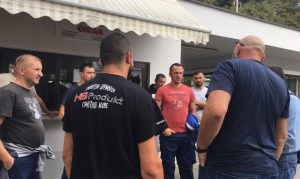
Regarding the medieval conditions for foreign workers, members of the initiative found foreign workers living in windowless, collapsing houses, sleeping on bare concrete in freezing temperatures. Many work on construction sites during the day and deliver at night—all for less than €500 a month.
When questioned, digital platforms claim they are not the employers, yet they unilaterally decide who is allowed to work, set the rules, and control the algorithms. Just yesterday, Wolt introduced a new mileage calculation that reportedly undervalues actual distances driven, further reducing worker pay.
Peović emphasized that the state bears responsibility for protecting these platforms and enabling their irregular status, effectively supporting a system of modern slave ownership. She announced she would seek signatures from the opposition to force a parliamentary discussion on this issue as soon as possible. She also called on healthcare workers, currently announcing their own strike, to show solidarity, noting that precarious and insecure labor is not an exception but a systematic government policy.
The General Secretary of Novi sindikat, Tomislav Kiš, concluded: “After feeling ashamed as citizens of a state that allows this treatment of foreign workers, I call on Prime Minister Andrej Plenković to take this problem seriously. I propose an urgent meeting including the Minister of Labor, the Minister of the Interior, the Ombudsman’s office, and union representatives to resolve the exploitation and discrimination based on origin, nationality, and skin color.”
“Otherwise,” Kiš warned, “we will turn to international human rights organizations. We have the evidence. We will hold the Government of the Republic of Croatia responsible for any future xenophobic incidents resulting from their failure to address these systemic problems.”