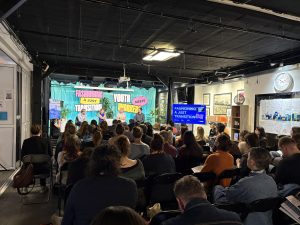
The marking of the National Day for the Elimination of Violence Against Women was seen by members of the Association Zora and the Croatian Centre for Workers’ Solidarity as an opportunity to hold a public debate on methods of struggle and possibilities for organization in the textile and leather industry.
Over twenty thousand workers, mainly employed in private factories, work long hours for minimal pay, often facing violations of workers’ rights and harassment in the workplace. A very low level of union organization has resulted in the inability to achieve better rights.
As a call and warning to all industry employees, a public hearing titled Organizing for Better Working Conditions was held on Saturday, September 21. In the Zrinski Hall of the Scheier building in Čakovec, workers from the industry gathered to discuss working conditions, problem-solving, experiences, and trade union struggles. Speakers included Ana Vragolović from the Croatian Centre for Workers’ Solidarity, former domestic laundry factory (DTR) worker Kata Šečić, and Mario Iveković, President of Novi sindikat. The panel was moderated by Zlatan Topalović from the Work Portal.
The discussion focused on how to negotiate collective agreements, combat verbal and psychological violence, prevent discrimination based on gender or other grounds, determine when lawsuits and criminal complaints against employers are possible, and why solidarity among workers is essential.
The debate also addressed the role of foreign brands, which generate billions in profits and enter Croatia seeking cheap labor. Private owners exploit employees through threats, non-renewal of fixed-term contracts during pregnancy or for “inappropriate” behavior, and by maintaining fear and powerlessness, thereby enforcing obedience and high exploitation.
According to the speakers, the state portrays northwest Croatia as the most competitive region, offering financial and other incentives to attract foreign investors under the guise of “saving the industry,” while failing to monitor how private owners treat workers.
-“In the textile and leather industry, prices are dictated by global brands and retail chains, which is a problem for all industry employees. Labor costs account for only 5–12% of the producer price at which Croatian suppliers deliver their products, which is unacceptable. As a global network, we will work to improve conditions for workers worldwide,” said Mario Iveković, concluding that the situation cannot improve without collective resistance.