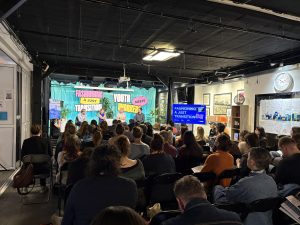
“Today’s fashion promises sustainability, conscientiousness, fair and green politics, but without transparency and wages from which one can live. A shirt made of organic material produced for poor wages is not sustainable nor should it be considered as such,” believes Clean Clothes Campaign. This international organization that fights for the rights of workers in the textile industry has developed Fashion Checker, a tool that provides data on supply chains and the production method of major global brands.
The global clothing industry employs about 60 million workers worldwide, and 80 percent of them are women. Long working hours, inadequate working conditions, health problems caused by difficult working conditions and poor salaries are a reality of textile workers around the world.
“I have problems with my stomach, I had surgery because of poor nutrition, and I have to be careful what I eat. But I can’t afford a quality meal. The pastries they bring to our company are from waste flour,” said one worker from Croatia to researchers Clean Clothes Campaigns (CCC), an international organization that fights for workers’ rights in the textile industry.
This worker and other textile workers around the world mostly produce for large fashion brands, i.e. companies that own them, which control the entire fashion industry. Some of them are Zara, Mango, Bershka, H&M, Nike, Adidas, Benetton and others, whose headquarters are located mainly in the west of Europe. Fashion brands make billions of dollars of profit over the backs of workers, and this wealth is based on cheap work, which is one of the causes of miserable wages in the textile industry, and consequently also bad working conditions.
The fashion industry works by brands ordering products from factories from a number of countries. These factories are their suppliers and are interconnected by production contracts. Some factories are owned by brands, but this is a rarer situation, because it means greater responsibility and greater costs for the brand it owns.
Brands pay their suppliers for goods, but that price is quite low, because their ultimate goal is to earn as much as possible and pay as little as possible. This problem is followed by another – since supplier companies also operate on the market, that is, they have a profit agenda, they also adjust the amounts that brands pay for their goods. The price that brands pay to suppliers should cover factory production costs, purchase of production materials, product shipping, labor price and profit margin for the factory. Workers are left with deprivation, because their salaries are the easiest cost to cut.
Photo: CCC/country profile – Croatia 2020.
Another factor that affects the low material rights of textile workers are the legal minimum wages. Governments of countries where clothing for the fashion industry are produced keep minimum wages at the same level in fear that brands will not divert orders to countries where labor costs are even lower. For example, production in Croatia is an advantage for German and Italian fashion brands, due to its proximity and membership in the EU (which means that there are no customs duties and similar costs). However, if the salary in Croatia increases too much, the brand will prefer to move production to another country of cheap labor, such as Georgia, or even to Asia. This is the reality of the fashion industry, and it means that minimum wages are never raised to an existential level (consistent with rising costs for basic needs).
In addition, during the coronavirus pandemic, many brands made the worker’s position even more difficult: when the quarantine started and the consequent closing of stores in many countries, they began to cancel earlier contracted orders to their suppliers so that they would not have “unnecessary” losses. At the same time, factories in supply chains left without a way to cover production costs and workers’ wages. Many factories closed, and thousands of workers were fired.
Wages below the poverty line
Salaries in the textile industry mostly revolve around the legal minimum wage, with which workers can cover only part of their living expenses.
“With HRK 3,000, I barely cover the grocery store. My husband pays utilities, my daughter worked in a season,” said the worker from Croatia to CCC researchers. Another adds: “I wish I wasn’t in a spasm all the time. I always have 10 kunas in my wallet, but I’m just looking at how not to spend them.”
According to research conducted at the end of 2019. The minimum wage in Croatia is 64 percent of the amount considered the threshold of poverty. The gap is even greater when we compare the minimums with the amount of the so-called living Wage, advocated by CCC. According to their definition, a living wage should be sufficient so that workers and their families can afford a decent standard of living. It should be earned in a standard working week with a maximum duration of 48 hours, and must cover the costs of food, water, housing, education, health care, transportation, clothing and discretionary earnings, which includes savings for unexpected situations.
The minimum wage in Asia varies from 21 percent of a living wage in Bangladesh to 46 percent in China (according to a 2019 survey). In the production countries of Europe, we sometimes encounter a bigger difference, from 10 percent in Georgia to 40 percent of the amount of living wage in Hungary. In Croatia, the minimum wage is about 36 percent of the amount of living wage.
Many brands refuse to take responsibility for workers’ wages, even though they are the ones who primarily dictate labor prices. Due to the fact that they condition the cheapest production of clothing production prices are minimal, while market prices climb to dizzying heights. For comparison, the price of one shirt that the German brand pays to a factory in Croatia is about HRK 30 (which should be covered by the costs listed above), while the market price is from HRK 350 to more than HRK 1,000.
Photo: CCC
At the same time, brands claim that they produce ethical and sustainable. Very often it is only about empty words. For example, some of the sustainability goals of the German brand Hugo Boss are “without poverty” and “let’s stop hunger”. their workers in Bulgaria earn About HRK 1,500 per month, and in Croatia about HRK 3,000, or from 20 to 32 percent of a living wage.
The Clean Clothes campaign believes that brands should take responsibility for workers in the factories that produce for them, whether they are owned by them, or subcontracting factories. They should increase the prices they pay to suppliers, and since profit orientation is unlikely to do so voluntarily, activists and workers within the fashion industry will have to put pressure on them. In order for this to happen, we must first know a little more about their supply chains.
Under the pressure of CCC, some brands have already published some of the data. E.g. Hugo Boss posted On your website The names and locations of factories that produce clothes for them, but we do not know how many workers are employed in them, under what conditions they produce clothes, how much they earn, etc. Also, information about lower levels of the supply chain is completely missing. Cooperators, workers working from home, workers who produce and process raw materials are completely invisible. The situation is similar for many other brands, and some even hide basic information such as production locations.
False promise of sustainability
“Transparency in supply chains is the first step toward improving working conditions,” according to the CCC, but “it is not the solution. Brands that disclose data on production locations are not necessarily better than those that do not. Disclosure does not mean that wages and working conditions are superior; it simply makes it easier to determine who is responsible for labor rights violations.”
This is why CCC started developing FASHION CHECKER which is also available and in Croatian translation. It is a tool designed to increase transparency by providing data on the supply chains of major global fashion brands.
Are the workers who make our clothes paid enough to live? Does a fashion brand pay a living wage to workers in its supply chain? What is the gap between the actual wages earned by workers in a specific country and the estimated living wage? These are some of the questions Fashion Checker seeks to answer.
One of the most important pieces of data needed to put pressure on fashion brands is information on workers’ wages. This information is “currently the only reliable way to find out whether brands pay the factories in their supply chain enough to be able to function safely and fairly,” as explained on the Fashion Checker website. The emphasis is therefore on collecting wage calculations and interpreting this information through field interviews with workers conducted by trade unions and non-governmental organizations.
Such research has been conducted so far in five countries: Indonesia, China, Croatia, India, and Ukraine. For these countries, Fashion Checker provides information on working conditions, occupational safety, the gender pay gap, employment methods, working hours, overtime, and unions.
Another source of information is the questionnaires sent by the CCC to more than 90 brands, asking what steps they have taken to ensure workers in their supply chain are paid living wages. Through the main infographics, we first learn basic information about the brand: its headquarters, annual profit, and the countries where it produces.
Furthermore, the tool provides brand ratings for the payment of living wages: A being the best rating and E the worst. Brand transparency is evaluated in stars, and we can also find out if they have promised to pay a living wage, whether they have an action plan to achieve this, and more. If a brand has publicly disclosed its list of suppliers, that list can also be found on Fashion Checker. By clicking on the names of factories in the list, we learn more about them; to learn more about the brand itself, we can view its full profile.
Photo: Print Screen Fashion Checker
To collect additional supply chain data, the CCC collaborated with experts such as Wikirate and utilized information from the Open Apparel and Open Corporates registers. This research was funded by the European Union as part of the Clean Clothes Campaign project “Achieving Living Wages through Improved Transparency,” which is coordinated by Novi sindikat in Croatia.
“Today’s fashion promises sustainability, conscientiousness, and fair, green politics, but it lacks transparency and wages people can live on. The payment of poverty wages directly impacts the sustainability and resilience of the entire economy. A shirt made of organic material produced for starvation wages is not sustainable, nor should it be considered as such. Systemic change in the fashion industry is an undeniable necessity, but the system must first provide decent living conditions for the millions of garment workers who are most affected by it,” the Clean Clothes Campaign believes.
The CCC holds fashion brands responsible for respecting human rights and paying living wage therefore, their primary demands are directed at them:
- Since the low prices that brands pay suppliers are one of the main causes of low wages in the textile industry, brands must commit to paying a living wage supplement for each order. This money would be intended directly for the payment of salaries instead of other production costs. In this way, brands can be sure that workers in their production chain earn enough to live. The amount must be sufficient to close the gap between the real worker’s salary and the living wage in its supply chain by December 31, 2022.
- Brands must publicly disclose information about their production chain in a format that activists and trade unionists can work with.
“It’s time to start using available data to highlight human rights violations in the fashion industry and get concrete, significant and measurable pay increases in the entire supply chain. Workers deserve better. Customers deserve better. It’s time to redistribute Wealth and power”, they say from CCC.

Co-funded by EU
Author of the text and cover photo: Ana Vragolović
The text was originally published on the Workers’ Rights portal, 31/03/2021 under the title “Fashion Checker – Check How Your Clothes Are Produced”