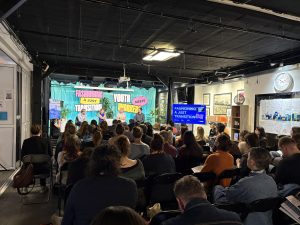
Today, at a press conference held together with the Regional Industrial Union (RIS), we presented the European Citizens’ Initiative to collect signatures for decent wages.
The “Good clothes, fair pay” initiative was launched by several international organizations, including the Clean Clothes Campaign (CCC), Fashion Revolution, Fair Wear, and Fair Trade, among others. In addition to Novi sindikat and the Regional Industrial Union (RIS)—both members of the Clean Clothes Campaign in Croatia—other members of the Coalition for a Living Wage are participating in the initiative: the Centre for Peace Studies (CMS), Human Rights House, PaRiter, the Independent Union of Croatian Workers (NSRH), Fashion Revolution Croatia, and the Center for Education, Counseling, and Research (CESI).
Mario Iveković, President of Novi sindikat, presented the initiative: “The goal of the initiative is to collect one million signatures from European citizens to request that the European Commission adopt a directive guaranteeing the right of textile workers to a living wage. This directive would be binding for all companies operating within the European Union, as well as those selling their products in the EU.”
He pointed out that a living wage is a constitutional category and that, according to the Constitution of the Republic of Croatia, every worker has the right to a salary that ensures a dignified life for themselves and their family.
“Unfortunately, in Croatia, a large number of workers barely survive on their salaries, let alone cover their family expenses. Although the minimum wage rises every year, the cost of living increases as well. According to our calculations, a living wage for Croatia in 2021 was €1,644. At that time, the minimum wage was €451, which amounted to only 28 percent of what the Constitution of the Republic of Croatia guarantees. That is why we need to set a deadline to reach a living wage—we should not be satisfied with 60 percent of the median salary, which is the threshold set in the European Directive on Adequate Minimum Wages.” Iveković concluded.
Fashion companies, or brands, at which this initiative is aimed, typically do not own their own factories. Instead, they outsource production to countries with cheap labor, thereby avoiding responsibility for the workers in their supply chain and shifting the blame for the lack of decent wages onto suppliers. However, these brands are the ones who place orders and pay suppliers prices that barely cover production costs. For example, if the German brand Olymp had paid at least double the €4 per shirt to the Orljava factory in Požega, the factory would still be in operation today.
The directive proposed through the European Citizens’ Initiative aims to change these poor purchasing practices of fashion companies and to oblige them to respect workers’ and human rights. If adopted, this directive will pave the way for changes in other sectors as well.
Jakov Kolak, a representative of the Regional Industrial Union (RIS), cited several examples from the sectors RIS oversees: “Corporate responsibility is also desperately needed in the call center sector. Large companies such as E.ON, Deutsche Telekom, Booking.com, and others are increasingly seeking a workforce in the Croatian labor market. This mostly involves outsourcing customer service and similar roles. These are major corporations that find cheap, high-quality workers all over the world and generate significant profits. However, there are currently no mechanisms to force them to take responsibility for ensuring decent working conditions and fair wages for the workers they profit from. Working in a call center is often a precarious and difficult job; it involves high levels of stress, constant monitoring, strict discipline, and various punishment mechanisms, alongside anti-union practices. Outsourcing jobs to low-cost countries must carry a clear responsibility for the working conditions and the quality of life of the workers involved.”
He pointed out that neither employers nor the state would take action if the problem was simply explained to them or if they were merely asked nicely: “If that were enough to solve the problem, we wouldn’t have the situation with personal assistants for people with disabilities—another group of workers we began organizing. Since 2006, they have worked for as little as 2,000 or 4,000 HRK (approx. €265 to €530) a month. For 16 years, the state has lacked the will to resolve a situation where people, who perform such humane and socially important work, live on the edge of existence. This year, their salaries only increased because the national minimum wage was raised.“
Kolak concluded that wages only align with inflation in workplaces where there is a strong and harmonious union membership—one that is ready to initiate collective bargaining and support their demands through strikes if necessary.
“It is also our responsibility as unions to utilize our knowledge and infrastructure, engage in field work, and increase our membership. Along with this comes the responsibility of workers to accept that dignity in the workplace is something that must often be fought for—because it is their labor that drives the entire system, and that is where the greatest strength lies. This is the only force that gives us the chance to make a living wage and quality jobs a reality.” Kolak concluded.
Finally, Mario Iveković presented the campaign plan.
The Coalition for a Living Wage will begin collecting signatures for the petition on May 1st, International Workers’ Day, at our stand in Maksimir, Zagreb, from 10:00 AM to 4:00 PM. During the week of May 15th to 20th, signatures will be collected at several locations in Zagreb, as well as in other cities, including Karlovac, Varaždin, and Rijeka, which have been confirmed so far.
We also invite all interested citizens who wish to participate in the collection of signatures to contact Novi sindikat, RIS, or other members of the Coalition for a Living Wage.
Watch the campaign video here: https://youtu.be/8TsANAFNYcs
More information about the legislative proposal can be found in English on the official campaign website: www.goodclothesfairpay.eu. For all the latest news regarding the campaign in Croatia, follow our website at https://www.new sign.hr, the Novi sindikat Facebook page: https://www.facebook.com/NoviSindikatNS, as well as the pages of the other members of the decent wage coalition.
Sign the petition here: http://www.goodclothesfairpay.eu/