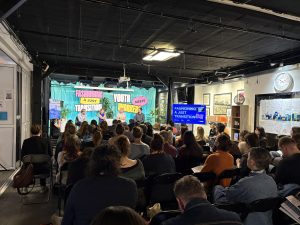
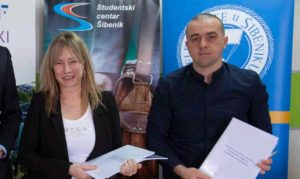
The conference was held on 23 January and gathered about seventy project participants, in front of whom scientific research on social dialogue in Croatia for the decade 2020–2030 was presented, along with proposals for further steps in connecting all partners: the state, trade unions, and employers.
According to the research, some external circumstances, such as labor migration and demographic factors, have been identified as major trends in the future, alongside technological changes, which will significantly affect the role of employers in the next decade. Political and economic changes overlap: the emigration of the working-age population leads to a shortage of labor across all categories. It is expected that, for these reasons, the interest of all partners in social dialogue will increase significantly in the next decade.
The biggest challenges for all partners in social dialogue (government, trade unions, employers) are related precisely to precarious employment and labor shortages. In the future, an even greater shift toward bipartite social dialogue is expected, along with an increased role for direct negotiation and employer–worker relations. The European Union is identified by respondents as an important influencing factor on social dialogue, noted through several aspects, mostly related to global impact, adoption of regulations, and capacity building.
The dominant theme in respondents’ answers regarding capacities for social dialogue in the future is that the government lacks readiness and expertise in social dialogue.
This is manifested through a lack of knowledge and skills, ignorance of the fundamentals or contemporary trends of social dialogue, or lack of focus on social dialogue. Respondents expressed a divided opinion regarding the role and capacity of trade unions: on the one hand, they see trade unions as an opportunity to strengthen the capacity for social dialogue; on the other hand, as an obstacle.
Concerning employers, respondents provided mostly positive assessments of their competences, although the question remains how effectively they employ these capacities.
Among the conclusions of the research is that Croatia has a low level of public dialogue, which is certainly influenced by a low level of social capital, mainly manifested in the low level of trust that citizens have in institutions and, consequently, in each other. CERANEO’s research shows that respondents expect social dialogue to strengthen in the future. This also implies an increase in awareness of corporate social responsibility and the importance of social dialogue, while trade unions will need to articulate a strategy for a new form of union practice.
The project “Social Dialogue and Modern Industrial Relations – Yesterday, Today, Tomorrow: Opportunities and Perspectives – MFA 2030” is worth HRK 1,140,801.83 and aims to increase competencies for 80 employees and interested members of partner organizations through the development of training modules with study trips, exchange of experiences, and learning about best practice examples. The project is aligned with the Europe 2020 strategy.
.

ABOUT THE MIP2030 PROJECT
The project “Social Dialogue and Modern Industrial Relations – Yesterday, Today, Tomorrow: Opportunities and Perspectives – MFA 2030” achieves an increase in competencies for 80 employees and interested members of partner organizations through the development of training modules with study trips, exchange of experiences, and learning about best practice examples. It aligns with the flagship initiative “Programme for New Skills and Jobs” (http://EC.europa.eu/europe2020) and the Operational Programme “Effective Human Resources 2014–2020”, Priority Axis 4: Good Governance, Investment Priority 11, Target 11.ii.1: Developing the capacities of civil society organizations, particularly associations and social partners, and strengthening civil and social dialogue for better governance (www.ljudskipotencijali.hr). It is expected that project team members will receive further training to become experts in the field of social dialogue. Thematic promotional videos and a Facebook campaign will strengthen interest and promote new standards of social dialogue at the local and regional levels. The project innovatively approaches the revival of a culture of social dialogue through the involvement of eight independent experts, who, using the Delphi method, will answer questions about the real possibilities and development of new perspectives for social dialogue by 2030.
The strengthening of social dialogue is achieved through partner organizations. The city of Zagreb has a direct interest as one of the partners of the Tripartite Social Dialogue in the GSV of the city of Zagreb. Its project activities include promoting dialogue with social partners in local and regional self-government units. The development agency, as an incubator for young innovators and future entrepreneurs (i.e., employers), expresses interest in the project to familiarize its members with the benefits of social dialogue in their companies and environment. By engaging in project activities, it ensures the exchange of information among members of the local employment partnership coordinated by the city of Zagreb. The Croatian Conciliation Association adds value to the project, as the Conciliation Institute is one of the key priorities and strengthens the culture of social dialogue. The trade union headquarters of the Croatian Workers’ Union and the Aircraft Cabin Crew Union, by participating in the project, strengthen their own capacities for participation in social dialogue at the national and company levels, while simultaneously building capacities for social dialogue at lower levels for all their members.
Evo prijevoda koji zadržava administrativni stil tipičan za opise EU projekata, uz očuvanje točne strukture koju si tražio:
The project will implement activities to examine the reasons for the weakening of social dialogue in Croatia through research based on a comparative analysis of the Croatian social dialogue framework with the social dialogue frameworks of four other EU countries (Sweden, Germany, Italy, and Poland). The research results are intended to contribute to the setting of new social dialogue standards in order to align them with the achievements of EU social dialogue. This activity provides support to partner organizations, which will use the research results to promote and advocate for the development of new social dialogue models. Through a partner initiative, the project invests in the development and improvement of social dialogue and achieves an increase in the professional competencies of 40 representatives from partner organizations who will be involved in training programs. With the goal of building the human resources of social partners, four thematic roundtables will be held: “Action Frameworks for Youth Employment,” “Social Dialogue – Numbers or Substance?”, and “EU Mechanisms and Tools for Sustainable Social Dialogue,” along with a final conference titled “Sustainable Social Dialogue in Changed Industrial Relations 2030,” as well as the exchange of experiences and the introduction of best practice examples.
All information about the EU project of Novi sindikat MIP2030 can be found here: [link].