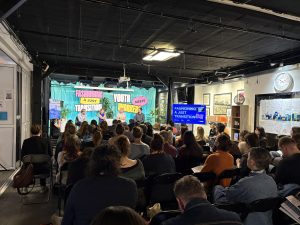
On Wednesday, December 11, at 6 p.m., the Park Boutique Hotel in Varaždin hosted a panel discussion organized by the Regional Industrial Union titled: “How to Achieve Higher Wages in the Textile Industry.” Although there is a common perception that the textile industry in Croatia no longer exists, it still employs about 20,000 workers in the clothing, textile, footwear, and leather sectors, primarily in Slavonia and northwestern Croatia.
“Almost 80 percent of the workforce in the textile industry are women.” said Dunja Kučinac, a journalist who, alongside fellow journalist Ivana Perić, is conducting research on working conditions in the textile industry for Novi sindikat and the international organization Clean Clothes Campaign.
They presented fundamental data on the textile industry and statistics on worker poverty in general.
“Although the Government of the Republic of Croatia has raised the minimum wage, these amounts are still insufficient for a dignified life due to the sharp increase in the cost of living. On average, women are paid 16 percent less than men; even when performing the same jobs, they earn 9 percent less—often due to more frequent sick leave, maternity leave, and similar factors. According to data from the Croatian Bureau of Statistics, 20.7 percent of people in Croatia are at risk of poverty or in severe material deprivation. Within this group, the majority are over 65 years of age, and the proportion of women is significantly high at 38.8 percent.” stated Ivana Perić.
She also noted that CBS (Croatian Bureau of Statistics) data showed that nearly 40 percent of people could not afford a week-long vacation away from home for all family members. Furthermore, 41.4 percent could not cover unexpected expenses, such as appliance repairs, medical bills, or funeral costs.
The same results were obtained by Novi sindikat in a survey we conducted in 2019 within the textile industry, which was published in the booklet Country profile: Croatia. Back then, workers told us that a normal vacation—one where they could truly rest—was just a dream. They explained that they had to go into overdraft or borrow money whenever they faced a large, unforeseen expense. Those with children face a particular struggle at the beginning of the school year, wondering how to afford new books, clothes, and supplies. When asked if they could save any money at all, they simply laughed. Whether the situation remains the same will be revealed by this year’s survey, the results of which will be published next year.
Dunja Kučinac noted that more than 50 percent of female workers in the textile industry are over 45 years old, with the majority aged between 50 and 54. ‘These figures show that the textile workforce consists predominantly of older women. This can, and should, be directly linked to poor working conditions and low wages,’ Kučinac stated.
In addition to the current poor conditions, news about the textile industry today is mainly heard through media reports of factory closures.
‘At the end of September, the Leonarda factory in Daruvar, which produced for Benetton, was closed because their subcontractor, Benetton from Osijek, halted orders. All thirty workers lost their jobs. This summer, bankruptcy was also declared at the Sisak factory Zlatna igla Siscia due to a debt of about 5 million euros, resulting in 120 layoffs. This domestic factory mostly performed finishing work for foreign clients. In October, bankruptcy was also declared at the Jadran sock factory due to significant financial losses.’ Kučinac added.
Furthermore, the Varaždin textile giant Varteks has been in a critical situation for a long time. The 100-year-old plant entered bankruptcy this year, and about five hundred workers were laid off. Varteks has continued operations on a reduced scale, retaining its retail business and a smaller portion of production.”
Some textile factories closed more than twenty years ago—such as Revija Šibenik—and yet, three hundred workers are still waiting for their nine unpaid wages. Novi sindikat calls the government on a regular basis to settle these long-standing debts..
Jakov Kolak of the Regional Industrial Union (RIS) stated that the average wages for textile workers range between 650 and 850 euros. Companies have kept workers on the minimum wage from the very beginning, consistently claiming they cannot afford to pay more. However, despite the recent increases in the minimum wage, these companies continue to operate in Croatia, proving that their explanations are merely excuses to keep wages stagnant.
The Regional Industrial Union sought to reach textile workers—primarily those from Calzedonia, which employs over 2,000 people in northwestern Croatia—with the goal of organizing and uniting them in the struggle for better conditions. However, they hit a wall.
“We tried to find out more about the working conditions in these companies, but it was extremely difficult to reach anyone willing to talk to us, even through family or friendship ties. If you search online, you won’t find any information about them except for promotional articles. The fact that conditions are poor is ‘common knowledge’—everyone talks about it privately, but no one dares to speak publicly or approach the Union.” Kolak explained.
One piece of information that RIS managed to obtain is that within Calzedonia’s companies (Compromiss, Intinova, Ytres, Tubla, and the Ducal warehouse), management has its own “worker representatives,” whom employees often mistake for a legitimate Union. Because of this, workers distrust unions, perceiving them as bodies that collaborate with management to oppress workers while retaining privileges for themselves.When unions operate in this manner—acting in the interest of the employer rather than the worker—they are known as “yellow unions.” Authentic unions should fight alongside workers for higher wages and better working conditions.
Despite these obstacles, RIS managed to gather responses from 117 textile workers through an anonymous online survey, with 95 percent of respondents coming from northwestern Croatia. The results are devastating.
“90.6 percent of respondents are either dissatisfied or only partially satisfied with their working conditions. 84.6 percent believe they are overworked or partially overworked, and 74.4 percent report that work negatively impacts their health. The vast majority—over 94 percent—are dissatisfied with their earnings, and almost all believe their salary is insufficient to cover basic life needs.” said Jakov Kolak, presenting the survey results.
When asked to identify the most significant problems within their companies, the workers provided harrowing responses, citing “unattainable quotas and constant humiliation,” “a hostile environment, insults from the employer regarding sick leave, and unpaid Saturdays,” “working without heating while being pushed to meet excessive quotas,” “outdated machinery and low wages,” and “mobbing and a complete lack of adjusted working conditions.”
According to the survey, workers would most like to change the quotas and pay, as they find the attitude towards them problematic. Some of the quotes include: “humiliation contributes nothing,” “you can’t even use the toilet,” and “exploiting workers ‘to the Amen’ for 800 euros a month.” Some have complained about having too many night shifts and working on Saturdays, while others expressed a desire to change their boss.
The responses also showed that the problems are not only financial; a more humane relationship is needed, both among coworkers and from superiors. One response was, “I would add a radio or any music,” another, “I would change the working conditions to make me feel like a woman, not a slave,” and one person wrote that she would simply like to change her chair. This last statement saddened the panel participants—that something so simple could not be resolved. Workers in textile factories sit on hard school chairs for their entire working lives, and due to improper posture, many suffer from pain and spinal, shoulder, and neck deformities, eventually becoming disabled.
Mario Iveković of Novi sindikat spoke about the structure of the industry and the reasons for low wages. He stated that foreign fashion brands—the fashion companies—make money off the backs of workers by paying minimum prices for their labor.
“The German brand Olymp paid a production price of 4.5 euros per shirt, and that price was expected to cover the entire cost of production, including all utilities and workers’ salaries. It is clear that they will cut salaries to make this work. At the same time, Olymp sold these shirts at prices ranging from 100 to 150 euros each.” Iveković explains.
When production in one country becomes too expensive for them, brands move to cheaper ones. Olymp also took advantage of the coronavirus pandemic to leave Croatia and cancel its cooperation with Orljava, a partnership that had lasted over 50 years. Now, it seems Benetton is doing the same—the brand in Croatia has one main factory in Osijek and 11 subcontractors in the surrounding areas, mostly in Slavonia. At the end of September, the subcontractor factory Leonarda from Daruvar was closed, and 30 workers were laid off.
“Because of this, and through communication with partners from Clean Clothes Campaign Italy, we suspect Benetton is leaving. If that is what they have decided, there is not much we can do to stop it. However, we can help the workers fight for their rights—for their salaries, should the company fail to pay them, and for their severance payments.” Iveković said.
He pointed out that this spring, the Corporate Sustainability Due Diligence Directive (CSDDD) was adopted. This directive commits companies to responsibility for workers and sustainable production throughout their supply chains. It can be used to put pressure on fashion companies to meet their obligations, as they are the ones who actually dictate prices and are the main culprits for the low wages of textile workers.
“Through the Clean Clothes Campaign, we calculated that brands would only need to give up a small part of their profits for workers to have a living wage—they would simply have to pay 8 euros for production instead of 4 euros.” Iveković pointed out.
Finally, the panel participants urged textile workers not to be afraid and to contact Novi sindikat or the Regional Industrial Union (RIS). These organizations can help them fight for better conditions and protect their rights. The Clean Clothes Campaign can also support this struggle through its member organizations across Europe, which can exert pressure on those responsible in various ways.