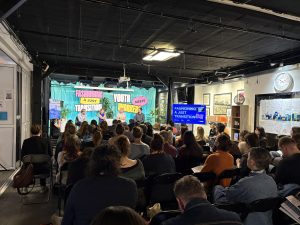
Yesterday, we held a press conference regarding the increasing obstruction of the freedom of trade union organization, specifically focusing on the example of Nova TV. The conference was attended by Nina Presečki (Novi sindikat Union Commissioner for Nova TV), Mario Iveković (President of Novi sindikat), and Tomislav Kiš (General Secretary of Novi sindikat).
Mario Iveković stated that cases where solving problems through standard trade union action is becoming nearly impossible are increasingly frequent, with organizing being most difficult in the private sector and the media. Nova TV represents a combination of both a private media outlet.
“We began our work at Nova TV two years ago. We started in the usual way introducing ourselves to the administration and spreading the information that good organization and collective bargaining can lead to better conditions for workers. The administration has never communicated directly with us, as they consider it unnecessary. While that is their right they appointed a liaison for communication the manner of that communication speaks for itself. The records we received were ‘hand-drawn’ I highly doubt such records are produced when they meet with business partners or anyone they respect. To me, this is evidence of complete disregard for the Union. If you ask them if they respect workers’ rights, they will say ‘of course,’ noting they even allowed us to meet with the staff. However, during those meetings, it was very clear to us that their goal was to discourage people from responding or attending.” Iveković said regarding the initial obstacles in organizing.
First, they did not send her the required reports, despite her being a Union Commissioner who took on the role of the Works Council. No reports on business operations, employment, etc., were provided. Secondly, they did not include her in consultations regarding decisions relevant to the position of workers.
“We filed a complaint with the Labor Inspectorate because one of the basic obligations of the employer was not respected. The Inspectorate conducted an investigation and started proceedings against Nova TV, but only because they failed to send reports. The part regarding consultations, although we provided extensive attached materials, was not even addressed. The message being sent is: you must submit reports, but you do not have to conduct consultations regarding labor issues.” Iveković points out.
He then explains the direct discrimination against union members: “In September, a group of Novi sindikat members in Split the cameramen were dismissed. It was carried out in such a way that on the same day, the Union Commissioner was rushed to the post office and told that consultations were being conducted. However, that very same day, the workers were informed they could go home and would no longer be working for Nova TV. Also, on that same day, an announcement was made that Nova TV would no longer employ its own cameramen but would outsource the service to a private firm. All those who were not members of Novi sindikat were offered contracts with that new firm.”
“They later claimed they had waited for the consultation process and made a final decision a month after receiving a negative opinion from the Commissioner. This means they conducted the consultation in such a formal and brazen way that a serious state should not allow it. Furthermore, the fact that only union members were not offered jobs in the new company clearly points to discrimination based on union membership.” Iveković emphasized. It is important to note that, according to the law, in cases of outsourcing, employment contracts must be transferred if the new firm takes over all work from the previous employer.
One of the problems that most affects Nova TV workers is working hours, as work is organized according to the principle of ‘it must be done when I say so,’ under the pretext of emergency situations. However, it is impossible for every day to be an unforeseen situation in reality, it is a labor shortage and an overload of existing workers. This is the way most media companies conduct business, as confirmed by the Croatian Journalists’ Union.
The Union Commissioner of Novi sindikat described her experience of the situation: “It is especially difficult and painful to be a Union Commissioner in such a media house. Working in news programming as part of Production Services, my job is to monitor the content of news broadcasts. In these programs, journalists talk almost daily about violations of workers’ rights that occur systematically in our country. There is extreme hypocrisy present, and it creates additional pain. People who joined the union did so with fear because stories are circulating, and it has long been known that at Nova TV, a union must not be present. Some members were even blackmailed regarding raises, being told they would never receive one again unless they left the union. Intimidation, blackmail, and obstruction of all kinds are present. Personally, I endure dirty looks, remarks, and mockery for being a commissioner, and it comes from the highest levels down to the lowest.”
Finally, Iveković stated that the state of Croatia should guarantee freedom of organization, the right to collective bargaining, and all other human and civil rights primarily the right to a living wage. Otherwise, the norms prescribed by the European Union (e.g., 80% coverage by collective agreements) will remain merely fictitious. He also announced a series of future conferences on the same topic: the dignity of workers and the endangering of fundamental labor rights in Croatia and beyond.