International Women’s Day, commonly known as the 8th of March, is a day that traditionally marks the centuries-old struggle for women’s rights. Awareness of the importance of this struggle has been developing since the 19th century, when the fight for women’s rights was mostly led by female textile workers.
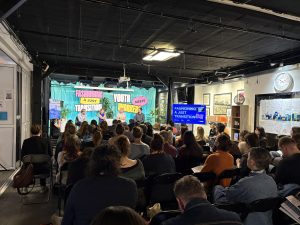
On the occasion of International Women’s Day, and in accordance with its history, Novi Sindikat gathered representatives of the fashion industry in Croatia for a panel discussion titled: “Fashion Law: The Personal, Public, and Political Side of Women’s Work in the Fashion Industry.” Through the debate, accompanying content, and the presentation of several aspects of fashion and the fashion industry, we pay tribute to the pioneers of the fight for women’s rights.
Throughout the evening, in the creative space of the Zagreb “Lidža” (Lodge), all attendees were guided by moderator Tena Lavrenčić, a fashion activist, communications specialist, and director of Fashion Revolution Belgium, the largest Belgian movement for women in the fashion industry.
“Fashion is a women’s issue because the biggest consumers of fashion are women. According to some studies, 80% of those working in the fashion industry are women. Movements such as ‘slow fashion’ are an alternative to the fast fashion system, and they are also run by women. Without women, there is no fashion.” Tena Lavrenčić pointed out.

In addition to Tea, that evening the panelists included Lea Vene from the Center for Fashion and Clothing Research, Ana Vragolović, representative of Novi Sindikat, and Anamarija Matanović, representative of the women’s rights group Brod from Slavonski Brod. They were joined by three representatives of slow fashion brands: Nika Vrbica, who presented her brand Salicula, Vedrana Jurišinac, who spoke about the brand Dada i Dunda, and Ivona Gray, who shared more about the brand Darkona.
The special guest of the evening was Mirjana Obradović, a former employee of Orljava, where she worked for 30 years. She stated that the working conditions were poor. Wages were paid according to the “norm” of the work completed, which meant the entire company was expected to produce about 1,700 shirts per shift, and sometimes even 2,000. However, this was an extremely difficult norm to achieve; realistically, between 1,200 and 1,500 shirts were finished, depending on the complexity of the design. In the last few years, the company had about 300 employees, with approximately 170 workers holding permanent contracts. She explained that part-time contracts were often bypassed because the employer hired new workers every three years to receive incentives from the Croatian Employment Service (HZZ).

Lea Vene from the Center for Fashion and Clothing Research emphasized the importance of exchanging experiences between fashion industry workers and consumers. “What is valuable is creating a space where you can hear different experiences, from both the workers and the fashion consumers themselves. The experience of dressing is very important; if we talk about Orljava, we should look at those garments as something personal rather than just objects of mass production.” said Lea Vene.
Anamarija Matanović from Brod – Women’s Rights Group from Slavonski Brod, spoke about the impact of fast fashion on women’s mental health. She shed light on the reasons for impulsive shopping, which is often driven by emotion, and the way the fast fashion industry manipulates consumers to maximize profits. She also pointed out that fast fashion represents a significant environmental problem, as clothing items are often worn and thrown away after only one use.
The role of Novi Sindikat in the fashion industry was explained by representative Ana Vragolović. In her presentation, Vragolović assessed negotiation and strikes as methods for achieving better working conditions. She pointed out the necessity of putting pressure on brands within the fast fashion industry, as workers who produce for large companies are poorly paid, and in some cases, not paid at all. A recent example is the case of the Orljava workers; although the factory closed, with the help of Novi sindikat, the workers successfully fought for their severance pay.
In order to better explain why clothing items should be viewed as something personal, the panelists used the example of Olymp shirts produced at the Orljava factory. Olymp shirts accounted for 90% of the factory’s total production. At the beginning of the COVID-19 pandemic, all those orders were cancelled, which led to unpaid wages for the workers. The German brand Olymp has not yet admitted liability, and mediation is currently underway at the OECD because the Novi Sindikat and the workers believe that Olymp should take responsibility and pay at least symbolic compensation for everything they suffered, given that it did not participate in the severance payments.
Another significant problem in the fashion industry is that information about closures or bankruptcy often arrives too late. While unions have been strengthened, the industry finds itself in difficult times. In fact, before the 1990s, there were about 80,000 workers in the industry; today, there are fewer than 18,000. For example, Calzedonia employs about 2,000 workers, but the Benetton factory with about 350 workers has closed, Varteks is in bankruptcy with its workforce in Varaždin reduced to 200, and Sisak’s Zlatna Igla is also bankrupt and has laid off all its workers.
The biggest problem in the fashion industry today, as pointed out during the panel, is the fact that large brands pay the bare minimum for production. An example of such an unacceptable practice was the failed Orljava factory, where only about 4 euros was paid.

The second part of the panel was opened by moderator Tena Lavrenčić, who shared her vision for a fashion industry rooted in the spirit of slow fashion. In her opinion, the priority is to revive slow production while encouraging local manufacturing and the creation of higher-quality clothing. She also believes it is necessary to promote the practice of buying second-hand, repairing garments, and generally taking better care of the clothes we already own.
Three representatives of slow fashion brands—Nika Vrbica, Vedrana Jurišinac, and Ivona Gray—presented their work during the second part of the session.
Nika Vrbica based her brand, Salicula, on a combination of fashion design and painting, using hand-painted textiles and sustainable materials. The core idea of the brand is that adding decorations to existing garments can provide a completely new look, thereby reducing the need to purchase new clothing.
The brand Dada i Dunda was born from the years of experience and expertise of Vedrana Jurišinac, who creates unique pieces of women’s clothing by repurposing materials. Vedrana processes old fabrics to create new textiles (metraža), which are then given a second life in the form of original creations.

Sustainable, slow fashion accessories are the focus of Ivona Gray, owner of Darkona, a gothic brand for both women and men. Through her collections, she aims to demonstrate how fashion accessories can be creative and unique while remaining sustainable.
Clothes should be viewed as something personal, not as something fleeting. For this reason, it is crucial to hold and support events of this kind. By exchanging the experiences of fashion industry employees and consumers, fashion activism takes on a new dimension beyond social networks, it was concluded at the end of the panel.
Novi sindikat was founded in 2002 in Zagreb as a general-type trade union. This means that it organizes and represents workers across all sectors and activities throughout the Republic of Croatia. Because it sees the true meaning of unionism in the unification, rather than the fragmentation of workers, Novi sindikat works daily to connect and strengthen the trade union movement, transcending professional and territorial divisions. In its work, Novi sindikat fosters the values of independence, transparency, and unconditional commitment to the interests of all its members. Today, it counts approximately 3,000 members.
The article was originally published on March 14 on the portal regionalni.hr under the title: Message from the evening of fashion: together for a better fashion industry.
Photos By Joanna Pansini